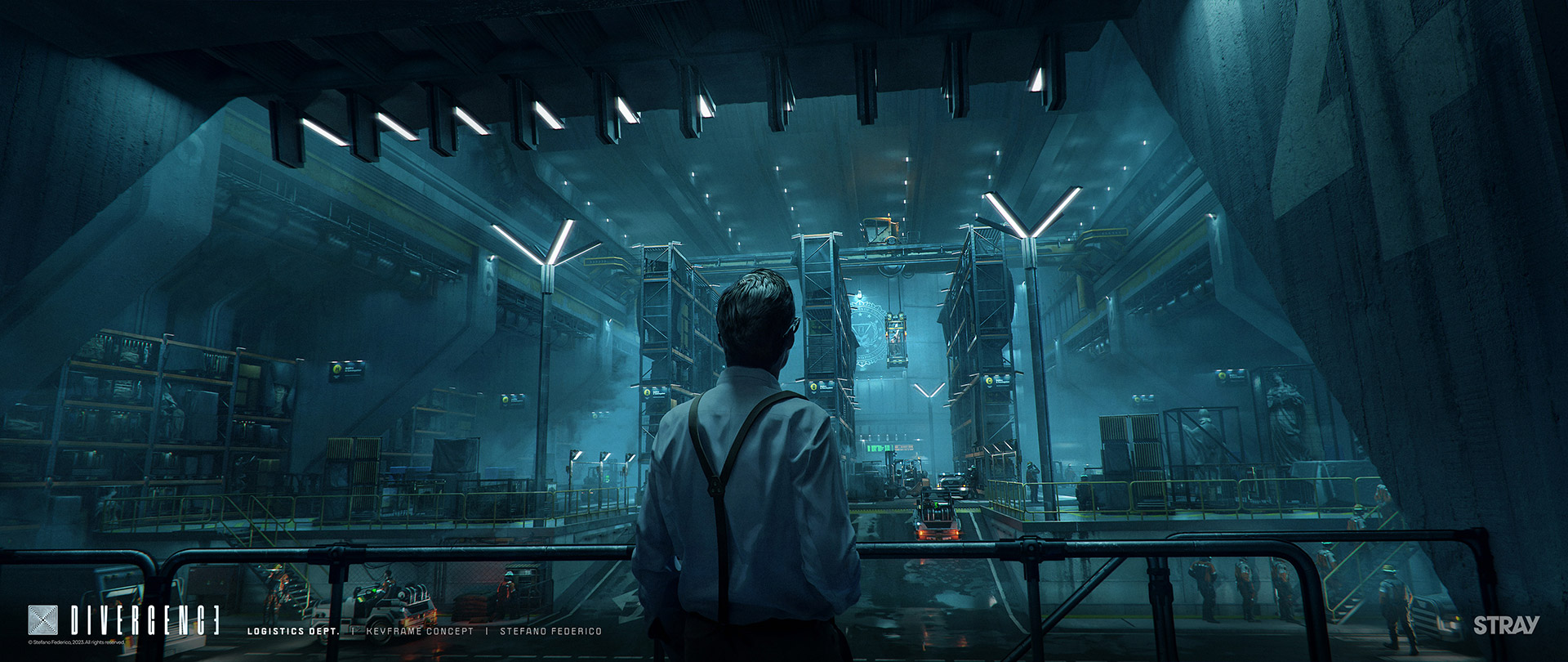
Story Bible — Anchor
Third installment of the Faction 4 series. Directly follows Drift. Working title: Anchor Status: Lore draft / pre-production
Premise
Janus wakes up in a hangar with his pockets turned inside out and a data module that should not still be there. Kirk is gone. The station is gone. The thirty-day window Ana gave him expired somewhere over the outer salvage lanes while he was losing consciousness.
He does not have a plan. He has the module, the multitool, the interface slate, and a name. That is more than he has operated on before.
Setting
The Hangar
A Rust Alliance salvage barge or deep-ring platform — large enough for full grav-plate installation, old enough that the machine oil has a history. Amber working lights. Steel-plate deck. One Allianz figure. No weapons visible.
Precise location not stated in current canon. Outer Veridion system, transit lanes between the salvage ring and the inhabited inner worlds.
The City — Outer Ring
A megacity on the inner-world fringe — Guild territory, or the edge of it, where Guild infrastructure meets the permanent sprawl of people who arrived with Apex contracts and never left when the contracts ended. The outer ring is the functional margin: warehouses, transit hubs, short-term residence blocks, service industries, and the specific ecosystem of businesses that exist because no one is looking hard at licences out here.
Name not stated in current canon.
Prologue — The Hangar (Continues from Drift)
The hangar pages from Drift establish the Allianz figure and the Fabric relay conversation. Anchor picks up directly afterward, from the moment Janus stands up.
Page 1 — The Inventory (Detailed)
You stand. The hypoxia residue is in your legs more than your head — a specific heaviness, not weakness, the feeling of a system that has been running on minimum and is recalculating its reserves.
You run the physical inventory before you run any other kind.
Your pockets have been searched. Not roughly — whoever did it was methodical and careful and returned everything to approximately where it was. You know this because you are also methodical and careful and you know where everything was. The MST-4 is in your left thigh pocket rather than your right. The TAP-7 is in your chest pocket facing the wrong direction. Your credit chip is present. Your wrist comms unit is absent — stripped before you woke, already noted.
The searching was professional. It was also incomplete.
There is one thing you do not find in your inventory because you do not know to look for it. At the base of your neck, slightly left of centre, there is a faint tenderness — the specific low-grade soreness of tissue that has been briefly traumatised and is in the process of forgetting it. You attribute it to the hypoxia, or the capsule cradle, or the specific way unconscious bodies are moved by people who are not being careful. You file it and move on.
This is the correct response for someone who does not know what it means. It is the incorrect response for someone who does.
The data module is in the capsule foam behind the left shoulder position. They searched your person. They did not search the capsule.
You look at it for one second. Then you pick it up and put it in your right thigh pocket, under the MST-4, which is now correctly positioned. You do this without changing your expression. The Allianz figure, still leaning on the cradle, notices that you found something. They do not ask what it is.
This is either courtesy or patience. You have not yet established which.
Page 2 — The Questions (Second Pass)
'Who searched my kit?' you say.
'Standard procedure,' the figure says. 'Salvage recovery. We need to know what we're dealing with.'
'What did you find?'
'A maintenance multitool.' A pause. 'And a diagnostic device that is not a diagnostic device.'
You look at them.
'We didn't log it,' they say. 'We don't work for anyone who would want to know about it.'
This is either the truth or a well-constructed version of it. You file it.
'The wrist unit,' you say.
'Scrapped. It had a Praxis Biomechanica registration tag. We don't keep Praxis hardware on board.'
Reasonable. You would have made the same call.
'How long?'
'Four days since we pulled the capsule. You were under for most of it. The hypoxia was significant.'
Four days. The thirty-day window Ana gave you expired — you do not finish the arithmetic because it does not require finishing.
Page 3 — The Offer
The Allianz figure stands. They have the easy economy of movement of someone who has been in variable gravity long enough that every motion is load-bearing and nothing is wasted.
'We're three days from port,' they say. 'Inner ring transit hub. You can disembark there or you can work passage. We're short a technician. Your file says you're not useless in a maintenance shaft.'
'My file,' you say.
'The Fabric frequency,' they say. 'People who know that frequency have a file. Not with us — with the network. We don't have access to the contents. We know the flag exists.'
You consider this.
'What port?'
They name a city. Inner-world fringe. Guild administration, nominally, but the outer ring runs on something older and more practical than administration. Transit connections. Supply lines. The kind of city where people go when they need to arrive somewhere without being specifically noted as having arrived.
'Work passage,' you say.
Page 4 — Three Days
The three days are not dramatised in detail. They are summarised in prose — Janus works maintenance shifts on a salvage barge, which is familiar enough to be grounding and different enough to be observational.
What he observes:
The crew are Allianz. Unmodified, all of them — no implants, no subdermal luminescence. This is normal for Allianz outer-ring crews and it means the Flicker does not register as a threat to them personally, which means their interest in Project Flicker, if any, is strategic rather than visceral.
The Allianz figure — whose name is offered on the second day and is not stated in current canon beyond a single-syllable call-name — does not ask about the data module again. They do ask, once, whether Janus has somewhere to go.
'I'm looking for someone,' Janus says.
'In the city?'
'Possibly.'
The figure nods. 'The outer ring has a Fabric node. Physical drop point, eastern transit hub, third level down. If your flag is active, they'll have information you don't.'
Janus files this.
Arrival — The Outer Ring
Page 5 — Disembarkation
The city from the docking approach is a specific kind of enormous — the kind that has stopped trying to look finished. The inner tiers have the Guild's characteristic vertical architecture: towers with integrated transit, everything connected, everything logged, neural implant infrastructure woven into the building management systems. The outer ring is what happens when that infrastructure runs out of maintenance budget and keeps growing anyway.
You disembark with the MST-4, the TAP-7, the data module, a credit chip that will last approximately eight days at outer-ring rates, and the Allianz figure's call-name and a single piece of information: eastern transit hub, third level down.
The figure does not come to the dock. They send someone to hand you a sealed card — a physical card, paper-weight composite, the kind that carries a contact cipher. No explanation. No instruction.
You put it in your left breast pocket, facing the correct direction.
Page 6 — First Impressions
The android enters the narrative here, invisibly. It does not appear in the prose. It is present in the city the way a fault line is present under a city — not visible, structurally relevant. See Writer's Note.
The outer ring smells like all outer rings: recycled air processed through filters that are adequate rather than good, food preparation from a dozen competing operations, the specific mineral residue of transit machinery that runs without pause. The signage is multilingual and partially broken. The people move with the purposeful efficiency of populations that have learned not to make eye contact with strangers who are standing still.
You are standing still.
You have a name. Ana Hamato. A departure date — Supply Transport 7, 2847.208. A destination not stated in the shipping manifest you have not yet accessed. A three-month gap between her departure and now, in which she could have gone anywhere the transit network reaches, which from a hub city is effectively everywhere.
You have the TAP-7 in your chest pocket and a public transit terminal six metres to your left.
You start with the terminal.
Interactive Section — The Search
Overview
Anchor's interactive section takes place in the outer ring of the megacity. It is the first installment with an urban environment — open-ended rather than constrained, with multiple locations, optional paths, and an investigation structure.
The core mechanic is information as resource: Janus gathers partial data from multiple sources, cross-references it using the TAP-7, and follows the chain toward Ana's last known location. The trail is cold by three months. It has not gone entirely cold.
This is the TAP-7's first active gameplay use.
Locations
Transit Hub — Public Level
The outer-ring transit hub. Functional, crowded, partially automated. Public terminals are here — arrival/departure logs, accessible to registered users. Janus is not a registered user of this system.
Available actions:
EXAMINE TERMINAL— identifies the log system as Apex Industrial standard-issue. TAP-7 compatible.USE TAP-7 ON TERMINAL/JACK IN— hardwire connection to the transit log. Takes two minutes. Leaves a log entry in the system security layer unless cleared. Access to: arrival manifests, departure records, registered-name search.SEARCH FOR ANA HAMATO— returns: no current registered residence. Last logged transit entry: arrival from outer supply route, 2847.214. Three days after she left Hephaistos-9. Port of entry: this city. No departure logged since.CLEAR ACCESS LOG— removes the TAP-7's entry from the security layer. Takes additional time. Optional but prudent.
Score milestone: +1 for locating the arrival record.
Transit Hub — Third Level Down
Below the public concourse. The Fabric node the Allianz figure mentioned. Physical dead-drop infrastructure — a specific type of terminal modified to accept Fabric cipher inputs. No signage. You would not find it without knowing what to look for.
Available actions:
EXAMINE TERMINAL— looks like a maintenance diagnostic port. Standard Praxis-format housing, repurposed.USE TAP-7 ON TERMINAL/CONNECT— Fabric cipher handshake. The TAP-7's Vanguard Corps intrusion suite contains, among its manually-patched additions, a Fabric interface protocol. Janus added this himself. He has not examined when or why he decided to add it.QUERY ANA HAMATO— the Fabric has a partial record. She transited through the hub. She used a second name for a short-term residence block — which name is delivered as a cipher string requiring a second TAP-7 action to decode.DECODE CIPHER— returns a street address in the outer ring's third residential sector. A short-stay block. The lease entry shows a departure date: seventeen days after arrival. No forwarding address.
Score milestone: +1 for accessing the Fabric node; +1 for the decoded address.
Short-Stay Residence Block — Third Sector
A functional outer-ring residential building. Entry requires either a current resident code or a hardwired override. Janus has neither of the former. The building's access panel is an older Apex format.
Available actions:
EXAMINE ACCESS PANEL— Apex Industrial standard format, Mark III. Compatible with TAP-7 bypass protocol.BYPASS PANEL— gains entry. Leaves a soft override signature in the building's access log. Clears in 24 hours passively or immediately with a second action.FIND ANA'S ROOM— cross-referencing the Fabric cipher data with the building's internal directory gives a room number. The room has been re-let. Current occupant has no connection to Ana.EXAMINE ROOM— the current occupant's presence is recent. Standard short-stay turnover. The room has been cleaned. There is one thing the cleaning missed.
Score milestone: +1 for entering the building.
The Room — What She Left
Cleaning crews do not remove items from behind wall fixtures. Behind the ventilation cover in Ana's former room — the cover secured by two non-standard screws, the kind that require a specific driver head — there is a sealed composite envelope.
Inside: a handwritten note on thermal paper. Seven lines. Her handwriting.
The note is not addressed to Janus by name. It is addressed to whoever is reading this, in the specific construction of someone who hoped it would be one person and was not certain enough to bet the note on it.
The note contains: a second address. A date — approximately six weeks from when she left the room. A single instruction: come alone and don't use your real name. If you have the module, bring it. If you don't, don't come.
The date on the note is five weeks ago.
Score milestone: +1 for finding the note; +1 for decoding the implied instruction (i.e. understanding she expected to be followed and built a dead-drop chain).
Janus is one week behind.
Score System
| Action | Score |
|---|---|
| Locate Ana's arrival record via TAP-7 | +1 |
| Access the Fabric node (third level) | +1 |
| Decode the Fabric cipher to get the address | +1 |
| Enter the residence block | +1 |
| Find Ana's note behind the vent cover | +1 |
| Maximum | 5 |
Failure Conditions
- Using TAP-7 without clearing access logs accumulates system flags. At threshold: Praxis Biomechanica corporate security receives an alert flagging an unregistered intrusion device on the Apex transit network. Consequence deferred to next installment — the city is now watching for the TAP-7's hardware signature.
- Not accessing the Fabric node: Janus finds the residence block via slower public-record methods. Costs additional turns. Does not block progress but lowers score.
- Confronting the current occupant of Ana's room: they have no information and the interaction creates a witness. Non-fatal, narrative flag.
Epilogue — One Week Behind
The note gives an address in a different part of the city — or a different city entirely; the address format is a Fabric routing cipher, not a street address, which means it resolves to a location only through the Fabric node. Janus cannot decode it at the transit hub. He needs a second Fabric access point.
He knows where he is going. He does not know if she is still there.
He is one week behind a woman who was already running when he was still unconscious in a capsule. She is fast and she is careful and she built a dead-drop chain without knowing if anyone would follow it.
He follows it.
Epilogue Page — The Arithmetic (Again)
You stand in the doorway of a room that is no longer hers and run the arithmetic.
She left the station on 2847.208. She arrived in this city on 2847.214. She stayed seventeen days. She left a note with a meeting date approximately six weeks from her departure. That date was five weeks ago. Which means she has been at the next location — wherever the Fabric cipher resolves to — for five weeks.
Or she has not been there at all. The meeting date passed without you. She will have made contingency plans. She builds contingency plans the way other people build excuses — not because things go wrong, but because she has already run the calculation that says they will.
The note said: if you have the module, bring it.
You have the module.
The MST-4 is in your right thigh pocket. The TAP-7 is in your chest pocket, facing the correct direction. The data module pulses amber through the fabric, slow and patient.
You are one week behind.
You have operated on worse margins.
Open Questions Introduced by Anchor
Resolved in this document (author decisions):
-
Where is Ana now? A different city. She left this one 17 days after arriving — the dead-drop chain leads one transit hub further in toward the inner worlds. She is not hiding; she is moving toward something. The data module is the reason she cannot stop moving.
-
The Allianz contact card — what is it for? A lifeline: safe passage back to the outer ring, no questions, on short notice. Single-use. The Allianz figure gave it because they want Janus gone before his hardware signature burns their operation. In Return, this card becomes the route back to Hephaistos-9.
Resolved in lore (established canon):
-
How does the Fabric know about Ana? She contacted them deliberately. She did not trust the Fabric — she trusted that the Fabric distrusted Praxis more than she did. She gave them her alias and one piece of Flicker-adjacent information in exchange for a single favour: that if anyone came with the right device signature, they would receive the alias. She does not know the Fabric gave it to Janus. She assumed it would be someone else.
-
The TAP-7 Fabric protocol patch — when and why? Janus added it during his last month with the Vanguard Corps, before he understood why. He had encountered something — a frequency, a dead-drop fragment, something from the Cinder-7 aftermath — and patched the device without filing it. The patch predates his awareness of the Flicker. The story will eventually surface this. The patch is proof the story started earlier than Janus believes.
-
Does Ana have a verification method at the next dead drop? Yes. She left a challenge that only someone who has physically held the module would pass: the module's amber indicator pulses at a specific interval she documented in its index layer. The answer requires having watched it. Anyone who found her note through interception without the module will fail. Janus will not know the test is happening until it resolves.
-
Whisper — do they know Janus is alive? Yes. The Fabric relay Janus activated in the shaft transmitted on a dead-drop buoy frequency Whisper monitors. They received the ping — a Vanguard-format device, that station, that date — and drew the correct conclusion. Whether they have told anyone else is a separate question. Whisper's current operating interest is the module. Those two things are now the same thing.
Open — to be resolved in later installments:
-
Praxis corporate security: they know a device — an unregistered Vanguard-format hardware signature on the Apex transit network, from a contract worker who should be dead. They have not yet connected it to the station because the kill team wiped those logs. The nanotracker closes this gap before Praxis's analysts do.
-
The nanotracker: every TAP-7 access, every Fabric node query, every building entry logged and transmitted. The headhunter android corroborates from the ground. Together they give the receiver a precise picture of Janus's investigation — one Janus himself does not have. He is the most surveilled person in this city and does not know it.
-
The headhunter android: the Allianz figure suspects a tail but reads it as a corporate surveillance unit, which it effectively is. The Fabric node operator does not know — the android's cover behaviour is too clean, and the Fabric is looking for humans with bad intentions. The android has no intentions of its own.
-
Kirk: extracted by the black ship. Location unknown. The question of what I'm sorry meant has not yet been answered.
Writer's Note — The Android Shadow (Spoiler)
⚠️ Do not surface to narrators or playtesters before this is revealed in-story.
The android is not a combat unit. It is a surveillance and recovery asset — a headhunter chassis running a long-duration observation protocol. Its function is to follow the tracker signal, log Janus's movements and contacts, and report. It will not act until instructed.
In Anchor, it is present but invisible. It should never appear in the prose as a character or as a threat. It is background texture: a figure that is in the same transit hub, the same outer-ring street, the same residence block corridor — always at a distance that reads as coincidental, always with a cover behaviour (maintenance, delivery, passenger traffic) that is plausible for an unmodified person.
The narrative rule: the player may notice it once, as a throwaway detail, if they examine their environment carefully. It reads as nothing. On a second playthrough, after the reveal, it is everywhere.
The android knows: - Where Janus is at all times via the nanotracker - Every transit record Janus accessed via the TAP-7 (the tracker pings on network-connected terminals) - That Janus is looking for someone (observed behaviour) - That Janus found something in the capsule foam (observed)
The android does not know: - What is on the data module - Who Ana is or why Janus is looking for her - That Janus has a Fabric protocol on the TAP-7
The moment of discovery — when Janus finds the tracker, identifies the android, and understands the geometry of his situation — is a major story beat reserved for a later installment. Its placement is not stated in current canon.
Narrative Tone Notes
Anchor opens the register outward — from the confinement of the maintenance shaft and the capsule into the grounded noise of an actual city. The tone does not become warm. Cities in this setting are functional and indifferent. The outer ring is the specific texture of infrastructure that was never designed for the people currently using it.
The investigation structure should feel like maintenance work: systematic, methodical, progress in increments. Janus approaches finding a person the same way he approaches diagnosing a fault — follow the signal, discount the noise, do not assume a failure until you have eliminated the variance.
The TAP-7 earns its place here. It is not a master key — it is a tool with a cost (time, log entries, hardware signature exposure) that rewards careful use. Players who clear their logs will feel that they are playing Janus correctly.
Ana's dead-drop chain should read as intelligence work, not paranoia. She built it fast, under pressure, with limited resources, and it held for three months. She is not a professional. She is someone who understood exactly how bad her situation was and moved efficiently.
The amber pulse of the data module should surface in prose at least once per scene from here on. It is a heartbeat that does not belong to anything biological. It is patient. It is not going anywhere.
See also: Characters | Timeline | Story — Drift | Story — Before the Incident