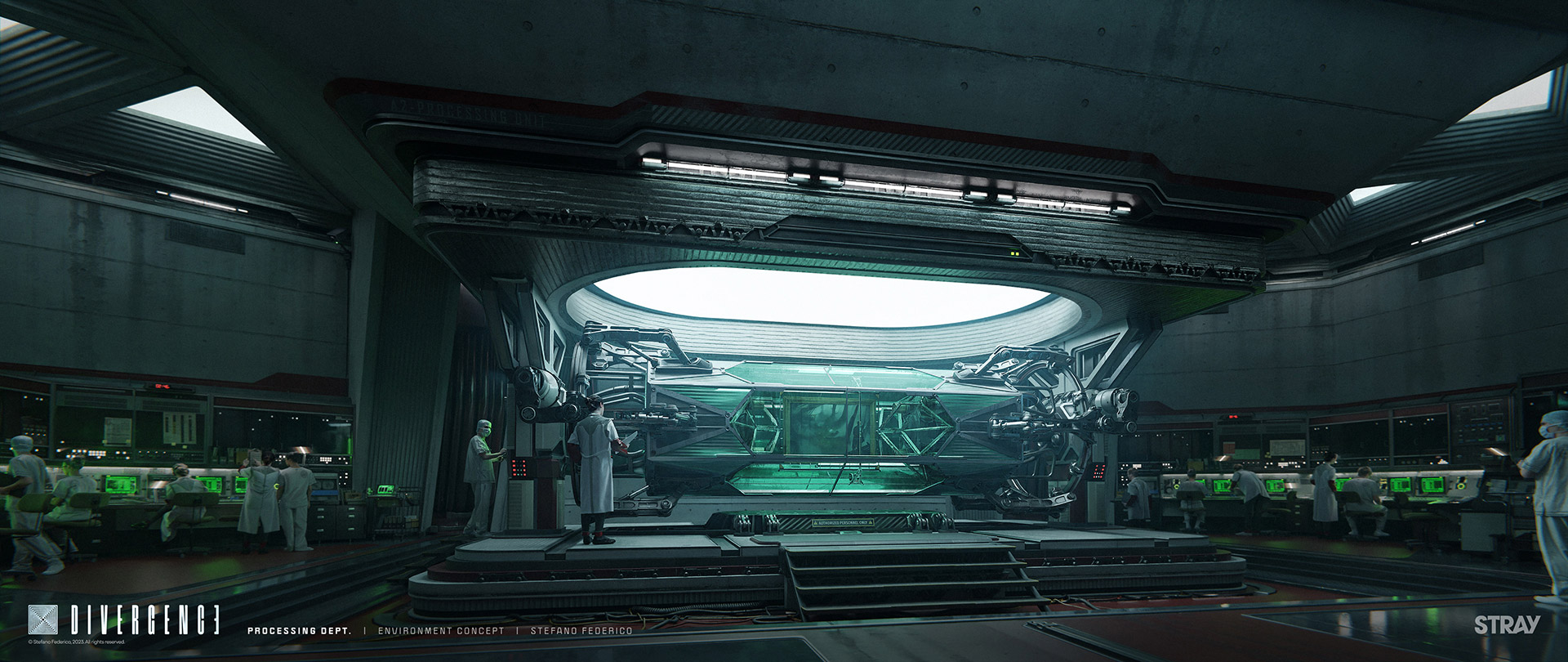
Story Bible — Before the Incident
Prequel arc to Echos in the Cold. Told as interleaved flashbacks across both Janus and Ana perspectives. Distributed across installments 1–3 and possibly beyond. Status: Lore draft / pre-production
Premise
The incident did not begin with a coolant rupture. It began with a junior researcher who found something she was not supposed to find, and understood it well enough to be afraid, and afraid enough to run — but careful enough to leave a trail only one person had any chance of following.
This is the story of how the data module got into Janus's hands before the kill team arrived. Told in fragments. Out of order. In the margins of a crisis.
Structure — Flashback Distribution
The pre-incident arc is not a standalone installment. It surfaces as flashback pages interspersed across the main story sequence:
| Flashback Set | Surfaces In | Trigger |
|---|---|---|
| F1 — Arrival / First Meeting | Echos in the Cold prologue or intermission | Janus sees the maintenance shaft emergency light at 520nm |
| F2 — The Second Meeting | Echos in the Cold intermission or epilogue | Janus handles the data module for the first time |
| F3 — Ana's Discovery | Drift prologue | Oxygen declining; Janus is alone with the module |
| F4 — Ana's Departure | Drift intermission | Kirk asks do you think anyone knows we're out there? |
| F5 — Dr. Gebreysius | Drift epilogue / Anchor prologue | The Allianz figure mentions the research team |
| F6 — The Bearing | Return compute room | Ana accesses the live relay; the bearing she memorised resolves on screen |
Characters — Pre-Incident
Janus (Year −1 to −0)
Thirty-five years old at arrival. Fresh off the Vanguard Corps exit processing and an undisclosed period of doing nothing very deliberately. The Praxis Biomechanica contract at Hephaistos-9 is described to him as routine maintenance support for an active research facility. He accepts it because the pay is 340 credits above the Apex service minimum and because the facility is far away from everything that requires him to have opinions about himself.
He is not looking for complications. He finds Ana Hamato.
Ana Hamato
Age: 28
Occupation: Junior research assistant, Praxis Biomechanica — Hephaistos-9
Specialisation: Probe telemetry analysis — automated sensor sweep
archiving for Project Flicker. Lower-tier work. The kind assigned to
people who are capable enough not to be liabilities but not yet senior
enough to be entrusted with the findings those sensors are generating.
Status during the incident: Off-station. Departed on the preceding
supply transport. Precise departure date not stated in current canon.
Status post-incident: Unknown. The supply transport reached its
destination. What Ana did when she arrived is not stated in current canon.
Ana is not clumsy, but she panics in the specific, precise way of someone who is very intelligent and knows exactly how bad a situation is before other people have finished realising it is bad. This makes her fast in a crisis and exhausting in the forty-eight hours before one.
She is working on probes. This is not glamorous. The senior researchers do not work on probes. Probes are data collection — passive, repetitive, the epistemic equivalent of taking someone else's notes. Ana knows this. She has been doing it for two years. She has developed, out of professional necessity, a very detailed understanding of what the probes were measuring and what the measurements should look like.
This is the specific kind of expertise that changes everything.
Dr. Aram Gebreysius
Age: 52
Occupation: Chief Scientist, Hephaistos-9 — Project Flicker
Employer: Praxis Biomechanica (contracted); reports to a division
of corporate research whose name does not appear on the public registries.
Status at the incident: On-station. Presumed dead.
Manner: Formal. Precise. Not unkind — he thanks assistants by name,
holds doors, remembers birthdays with the systematic thoroughness of a man
who has learned that these things matter even if he has not entirely
understood why. He is not warm. He is meticulously correct.
Gebreysius is the best scientist on the station. He is also, without knowing it, the mechanism by which the kill team is deployed.
He does not know what he found in Ana's worklogs. He knows it is important. He has spent thirty years learning to recognise when a result is significant without yet knowing what it means. He recognised it in approximately four minutes. He contacted his Praxis corporate liaison within the hour.
He did not know what the call would cause. He was doing his job.
Flashback F1 — Arrival / First Meeting
Surfaces in: Echos in the Cold, early — possibly as a prologue page triggered by the emergency lighting.
F1.1 — The Station
Hephaistos-9 is not welcoming. Nothing in the outer Veridion ring is welcoming — the Flicker has been chewing at the infrastructure for long enough that everything looks like it is one variance from a fault code. The docking approach takes forty minutes longer than scheduled because the secondary guidance array is operating on a manual override that the station crew have stopped filing reports about.
Janus notices the emergency lighting frequency before he notices anything else about the station. 520 nanometres. The same as Cinder-7.
He puts this in the drawer. He picks up his tool case.
F1.1b — The Kit Case
Janus has two things in his tool case that are not standard Praxis Biomechanica maintenance issue.
The first is a Sensar MST-4 multitool — palm-length, matte-black titanium, worn grip, twelve functions including two he has never formally identified. He bought it at a Rust Alliance salvage market in 2844, after he left the Vanguard Corps, for sixty-three credits. It was used. He did not ask. The two unidentified heads are the reason he bought it — something retrofitted from another tool family by the previous owner, and they worked when he tried them, which is the only qualification that matters to him.
The second is an Apex TAP-7 interface slate. Technically decommissioned Vanguard Corps field equipment. Technically not his to keep. He kept it because the decommissioning process involves surrendering the hardware to a quartermaster and the quartermaster at his last posting was not someone he was inclined to hand a network intrusion device to. The intrusion suite is four years out of date. He has patched it, manually, five times since. If anyone asks, it is a diagnostic tool. This is not entirely wrong.
Both items have been on his person or in his kit case for every day of the Hephaistos-9 contract. He does not think about them specifically. He thinks about them the way you think about the things you would miss if they were gone — which is to say he does not think about them at all.
F1.2 — The Laboratory Corridor, Research Level 3
The research sections are not Janus's domain. He is assigned to maintenance shafts, life support systems, coolant distribution — the infrastructure below the floor. He is in the research corridor because the floor panel on Lab 3-C has a seal fault and the maintenance request has been pending for eleven days and whoever filed it apparently did not understand the maintenance priority system.
The laboratory is occupied.
A junior researcher — young, slight, the particular posture of someone who has been hunched over a workbench long enough that standing upright requires a conscious effort — is in the middle of calibrating a probe telemetry array. The array is delicate. It is also in the way of the floor panel.
'I need to access the panel under your station,' Janus says.
She looks up. She has the expression of someone who was not expecting to have to manage a person in the next thirty minutes.
'I'm in the middle of a calibration sequence,' she says. 'It takes four hours and I cannot interrupt it.'
'The seal fault will compromise your floor heating,' Janus says. 'When the floor heating fails, the condensation cycle in this room will drop below the tolerance for your instrument calibration. You will lose the four hours anyway.'
A pause. She looks at him. She looks at the floor panel.
'Fine,' she says. 'But carefully.'
F1.3 — The Equipment
Janus is careful. He is, in the specific sense that matters, one of the most careful people on the station. He does not drop things. He does not snag cables. He works with the economic precision of someone who has been in tight spaces with expensive equipment since before he had a job title.
The telemetry array takes up more floor space than anticipated. The seal fault is in an awkward position. The access angle requires moving one of the array's support legs — which Janus explains before moving it, clearly and concisely, and which the researcher acknowledges with a nod that communicates she has heard him without necessarily being fully present for the information.
He moves the leg. He accesses the panel. He begins the seal repair.
The array, deprived of one support leg, develops a resonance frequency at precisely the moment the probe calibration sequence reaches its most sensitive interval. The resonance corrupts the telemetry baseline. The calibration fails.
The researcher stares at the screen for four seconds.
Then she turns to face Janus.
She is, it turns out, considerably more expressive when furious.
'That,' she says, with the controlled volume of someone who has decided that shouting would be unprofessional, 'was four hours.'
'And twelve minutes,' Janus says, reading the session log. 'I'm sorry. I didn't anticipate the resonance. I should have.'
The admission surprises her. She was prepared for deflection.
'Four hours and twelve minutes,' she says.
'Yes,' Janus says. 'I'll file a damage report and note it as my fault. If you need additional instrument time authorised, I can support the request.'
She looks at him for a moment. She is recalibrating something that is not the probe array.
'Just fix the floor,' she says.
He fixes the floor.
Flashback F2 — The Second Meeting
Surfaces in: Echos in the Cold, mid-game — possibly as an intermission page triggered when Janus picks up the data module.
F2.1 — Six Weeks Later, Canteen Level 2
They meet again because the outer-ring station canteen has six tables and forty-three regular occupants and the lunchtime scheduling is not formally regulated, which means that over the course of six weeks the occupants develop a de facto seating arrangement that is never discussed and never written down and which everyone observes with the solemnity reserved for things that have no rational basis.
Janus sits at the wrong table. Not maliciously. He was not briefed on the arrangement because no one is ever briefed on the arrangement.
Ana Hamato is at the table. She looks up. She registers who he is. The expression that crosses her face is brief and difficult to read — not hostility, exactly, but the specific wariness of someone who has filed the four-hour-and-twelve-minute incident in a category labelled people I do not need more of.
She does not move. He does not move.
They eat in silence for six minutes.
'Probe telemetry,' Janus says. Not a question. He has looked at the station duty roster because the duty roster is public information and he found himself — in the unexamined way of someone who is not examining their own motivations — looking at it.
'Yes,' she says.
'Is the array recalibrated?'
'It recalibrated fine.'
'Good.'
Another silence. This one has a different quality. The prior silence was avoidance. This one is two people who have run out of reasons not to have a conversation.
'Ana Hamato,' she says.
'Janus,' he says.
'Just Janus?'
'Just Janus,' he says.
She looks at him with the expression of someone who has filed this in a new category, one she has not yet named.
F2.2 — What They Are, After That
Not friends. The station is too small and too functional for the self-indulgence of full friendship — there is no time, and the Flicker research keeps the science team on irregular shifts that do not align with maintenance schedules. But they are something. They share the canteen table when it happens, which it does with increasing regularity because the de facto seating arrangement, it turns out, has a certain social gravity.
Ana talks about her work in the way of someone who has been told it is not important enough to talk about for long enough that she has started to believe it. The probe telemetry is boring. The senior researchers are doing better things. She is good at the boring thing, which is not the same as finding it interesting.
Janus listens in the way of someone who is better at listening than at most other social activities. He does not pretend the telemetry is interesting. He does not tell her it matters. He asks questions about the methodology because he is genuinely curious about systems and how they are structured, which is the closest thing he has to a social grace.
She finds this — unexpectedly, slightly against her better judgment — more useful than enthusiasm would have been.
They do not become close. They become the specific thing that is more durable than close: familiar. They know each other well enough that the knowing requires no maintenance.
Flashback F3 — The Discovery
Surfaces in: Drift prologue or early intermission — Janus alone in the capsule, the data module pulsing amber, oxygen declining.
F3.1 — What Ana Found
The probe array was designed to log passive EM readings from the Flicker at the edge of the Veridion system's magnetosphere. The readings were supposed to be background — documentation of a phenomenon already described in the senior research team's literature. Ana's job was to archive and flag anomalies for Dr. Gebreysius's review.
She flagged anomalies for fourteen months.
None of them were reviewed.
This is normal. The senior research team reviews what it considers important. Junior flags accumulate. Ana had developed, by month fourteen, a very detailed personal model of what the Flicker's EM signature should look like — a mental baseline built from the accumulated detail of several hundred thousand data points that no one else had looked at carefully.
On the day she found it, the reading looked wrong.
Not corrupted. Not equipment failure — she checked. Not an outlier. Wrong in the specific way that means the model needs to change.
She ran the archival data. Fourteen months of it. The signature was there, recurrent, in a band that the senior researchers had categorised as instrumental noise and excluded from their models.
It was not noise.
The signal had a direction. Not an origin point — she could not resolve an origin at the probe array's sensitivity — but a consistent bearing. Something was at that bearing, or moving toward it, or the Flicker was responding to something at that bearing. The distinction was not yet resolvable from her data. The direction was.
She did not know what the bearing meant. She knew what coordinates it passed through: the gravitational centre of the Veridion system, which contained nothing. A dead zone. Empty space with a surveying marker.
She noted it. She sat very still for forty-five minutes.
Then she started making plans.
What she understood and what she did not: Ana knew the signal was
real and that the senior team's noise classification was wrong. She knew
the bearing was specific and repeating. She suspected, but could not
confirm, that the signal was not a property of the Flicker itself but of
something the Flicker was responding to — something at or approaching
that bearing. She did not have enough data to say this with certainty.
She had enough data to be afraid.
This is not stated in current canon except as Gebreysius's missing
parameter and the contents of the compute room in Return.
F3.2 — What She Did Not Do
She did not flag it in the worklog.
She created a flag in the worklog. She filled it in with the standard notation for an anomaly of the category that required senior review. She correctly formatted the timestamp. She correctly attached the data reference. She left the flag in the pending queue where it would sit, unreviewed, alongside the other fourteen months of pending flags.
Then she archived the raw probe data in Archive Core 01 — the twelve- petabyte optical lattice that the station maintains for long-term storage of primary research data. She encoded the archive with her personal key. She added three layers of obfuscation to the data structure.
She did not know if any of this would be sufficient. She suspected it would not be. She did it anyway because her options were limited and the alternative was doing nothing.
She did not tell Dr. Gebreysius.
She did not tell her colleagues.
She did not tell Janus.
She thought about telling Janus.
F3.3 — The Cryptic Message
Three days before her departure, Ana sends Janus a message through the station's internal comms. It is six lines long. Its surface meaning is an apology for missing the last two canteen encounters and a mention that she is taking the next supply transport for personal reasons. Its actual meaning is not immediately legible.
The relevant lines:
There's a place behind the secondary coolant housing on Level 3 where the access panel hasn't been opened since installation. I left something there. It's not important, which is exactly why no one will look for it.
If someone ever asks you about probe data from months 12 and 14 of the Flicker archive, don't answer until you understand why they're asking.
I'm sorry I'm not better at goodbyes.
Janus reads this message twice. He files it in the drawer. He goes to the Level 3 coolant housing. He opens the access panel.
The data module is there. Twelve-petabyte optical lattice. Amber pulse. He does not know what is on it. He does not know why she left it there. He puts it in his kit case, in the pocket he uses for delicate components, and he does not tell anyone.
He does not ask because she said not to. He does not ask because the message was structured the way you structure a message when you know the recipient will understand more from the negative space than from the words.
He did four years in the Vanguard Corps. He understands negative space.
Flashback F4 — The Departure
Surfaces in: Drift, late intermission — Kirk's question about whether anyone knows they are out there.
F4.1 — The Morning She Left
Ana Hamato does not say goodbye to anyone formally. She submits a personal-circumstances transfer request to Praxis Biomechanica's HR registry four days before the supply transport's scheduled departure. The request is approved without comment. This is normal — junior researcher attrition on deep-orbit stations is high and the paperwork is designed for efficiency, not sentiment.
She packs what she brought. She leaves her workstation in the state required by the handover protocol. She does not leave a note for her colleagues. She does not go to the canteen on her last morning.
Janus, who has the message in the drawer and the data module in his kit case, sees her in the docking corridor. She is carrying one bag.
They stand in the corridor for a moment.
'You're leaving,' he says. Not accusatory. Registering a fact.
'The transport's at fourteen hundred,' she says.
'Right,' he says.
A pause.
'Did you find it?' she says.
'Yes,' he says.
She looks at him. The expression is the one he has seen before — the one that is recalibrating something she has not named.
'Don't let anyone scan it,' she says. 'Don't tell anyone you have it. If you don't hear from me in thirty days, assume I'm not coming back and use your judgment about what to do with it.'
'What is it?' Janus says.
'I don't know,' Ana says. 'Exactly.'
This is, technically, true. It is also the most careful lie she has ever constructed.
'Alright,' Janus says.
She nods. She picks up her bag. She walks toward the docking ring.
She does not look back. He watches her go with the expression of someone who is filing something in a new drawer and has not yet decided what to label it.
Flashback F5 — The Chief Scientist
Surfaces in: Drift epilogue or Anchor prologue — when Janus is in the hangar and the Allianz figure mentions the research team.
F5.1 — The Worklog Review
Dr. Aram Gebreysius reviews his team's pending work queue on the first Monday of every month. This is not a rule he was given — it is a habit he established in his second year of managing a research team, after a junior assistant's overlooked measurement correction sat unreviewed for six weeks and cost the project four months of recalibration.
He does not like overlooking things.
The review takes three hours. He works through it systematically. He reaches Ana Hamato's pending flags near the end — junior researcher, probe telemetry, low-priority. There are forty-seven pending flags, which is high but not unusual for an unsupervised telemetry archive of this duration.
He opens the most recent. He reads the notation. He reads the data reference. He opens the data file.
He reads it for six minutes.
Then he reads Ana Hamato's last-listed current status: Transfer — personal circumstances. Departed Supply Transport 7 on 2847.208.
Three days ago.
He reads the data file again.
F5.2 — What Gebreysius Knows (And Does Not Know)
He does not know what it means. Not precisely. He is a very good scientist and he recognises the signature of a result that overturns a prior model — the specific quality of wrongness that means the model was insufficient. He has spent thirty years learning to distinguish that quality from instrument error, and it took him approximately four minutes to do so here.
He does not know that Ana understood what it meant. He does not know about Archive Core 01. He does not know about the data module. He does not know she encoded the archive with her personal key before she left.
He knows the flag exists. He knows the data it references exists, and is anomalous, and is important.
He contacts his Praxis Biomechanica corporate liaison at 09:47.
He reports a potentially significant research development. He requests a consultation regarding data security and research continuation protocols. He uses the standard language for this kind of escalation. He has used it twice before in his career.
He does not know that this contact number routes through a division whose name does not appear on the public registries.
He does not know that the response — we are sending a team to secure the research data and ensure continuity — does not mean what he thinks it means.
He thanks the liaison and returns to his worklog. He intends to continue reviewing Ana's flagged data in the afternoon.
He does not get the afternoon.
Flashback F6 — The Bearing
Surfaces in: Return — a brief page triggered when Ana accesses the probe telemetry relay in the compute room and the live data resolves its direction.
F6.1 — What She Did Not Write Down
Ana did not include the bearing in Archive Core 01.
Not because she forgot. Because she was afraid that if the archive was found, the bearing would tell whoever found it exactly where to point their instruments — and she did not know who would be doing the finding.
She kept the bearing in her head. Latitude and longitude in the Veridion standard survey grid. Four digits and a decimal. She rehearsed it on the supply transport, in the transit hub, in the first accommodation she rented in the outer ring. She rehearsed it the way you rehearse something you cannot write down and cannot forget.
When Janus asks her, eventually, why she kept it back, she will say: because if I was wrong about what it meant, the coordinate was nothing. And if I was right about what it meant, I did not want it written anywhere until I knew who else was reading.
F6.2 — The Compute Room
In the compute room, fourteen months of live probe data resolves the bearing automatically. The system has been watching the sky. It shows Ana the direction that fourteen months of data now confirm.
It is the same coordinate she has been holding in her head.
She does not say this to Janus immediately. She looks at the display for a moment. Then she adds Gebreysius's parameter. The combined dataset processes and the screen updates.
What it shows is not just a bearing. It shows something forming at that bearing — measurable, growing, real.
She has been right for longer than she knew.
Open Questions Introduced by the Pre-Incident Arc
- What, precisely, did Ana find? The Azimuth bearing is established — what does the full processed dataset in the compute room reveal about what is forming there?
- Did Ana understand more than she admitted, even in the departure scene? I don't know. Exactly. How much of that was true?
- Where did Ana go? Did the supply transport reach a safe destination?
- Does Praxis Biomechanica know Ana left before the kill team arrived? Do they consider her a loose end?
- Did Gebreysius survive the incident? Not confirmed — listed as presumed dead. His specific fate is not stated in current canon.
- Does the Allianz know Ana exists? Does the Fabric?
- The thirty-day window Ana gave Janus has long since expired. What does use your judgment mean to a man who has been in an ejection capsule, then unconscious in a hangar, with no comms?
- Gebreysius's missing parameter — what data series was it from, and why was it classified above Ana's clearance?
Narrative Tone Notes
The pre-incident flashbacks carry a different register than the main installments. The station in peacetime is not the station in crisis — it is slower, dimmer, the particular tedium of people doing functional work in a place that exists to be functional. The Flicker is background noise. The research team is present, alive, going about its work.
The dramatic irony is total: the reader knows everyone in these scenes is dead or missing. The characters do not.
Ana should feel like someone running a calculation she has not yet finished — moving faster than her surface composure suggests, keeping more behind her eyes than she lets through. The bad conscience is not guilt about something she did wrong. It is the specific guilt of someone who knows too much about something she cannot fix and is choosing the only option that does not make it worse.
Janus in this period is more legible than Janus in the crisis. He is still detached, still communicating in structural assessments — but the drawer in his mind is opening, very slightly, in a direction he has not cleared for occupation. This is not stated. It is visible in the negative space, the way Ana's messages are visible in negative space.
Dr. Gebreysius should be handled without irony and without contempt. He is not a villain. He is a careful, competent man who did his job correctly and triggered a catastrophe. The story does not punish him for this. The story notes it and moves on.
See also: Characters | Timeline | The Azimuth Event | Story — Echos in the Cold | Story — Drift | Story — Return