Hephaistos-9
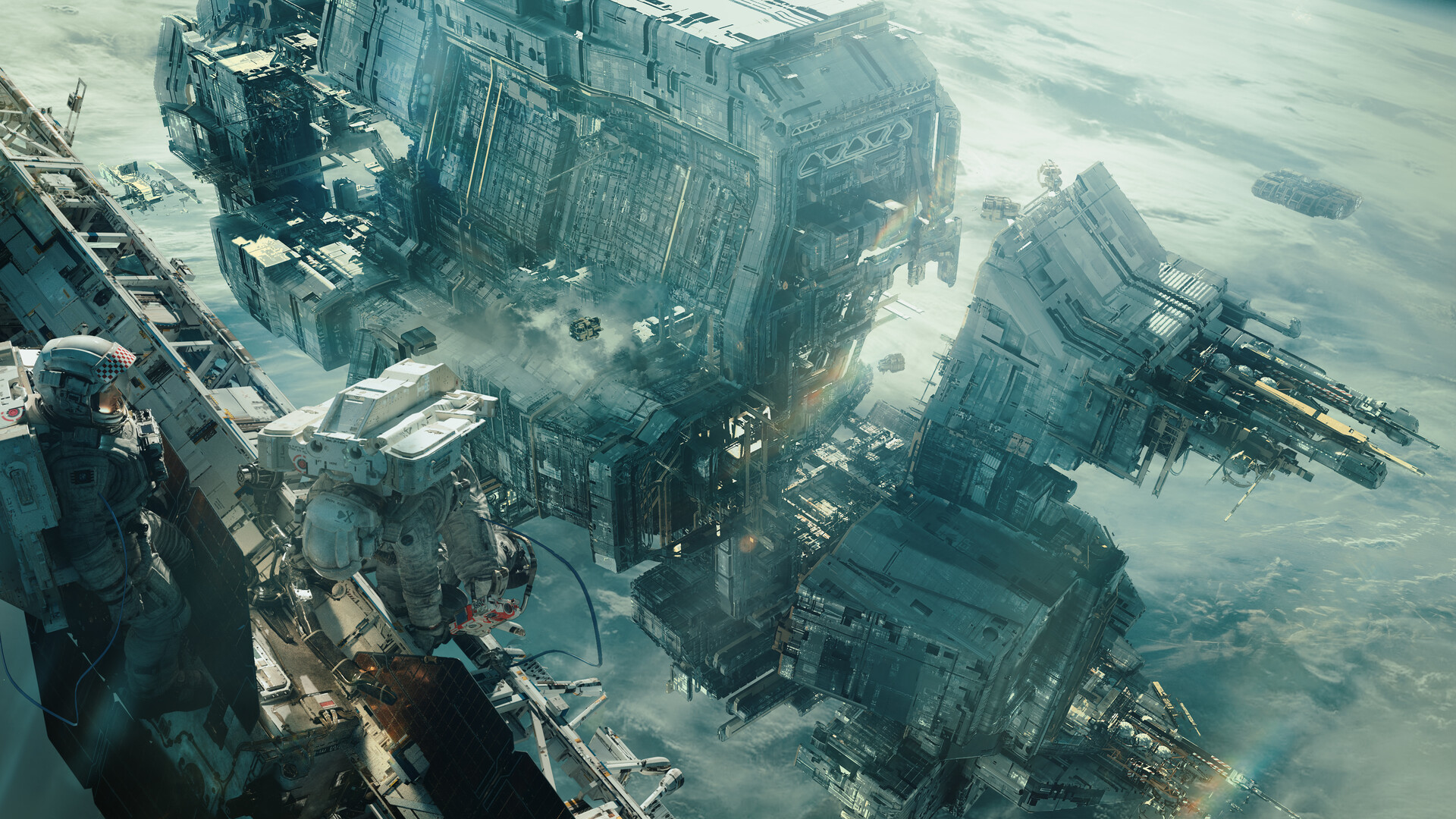
Zone: Deep orbit — gravitational shadow of the dead ice planet
Operator: Praxis Biomechanica
Classification: Deep-orbit installation, Category IV restricted
Population (operational): 43 registered — research staff, maintenance contractors, support crew
Status at story start: Total shutdown — sensors dark, comms dark, defences dark
1. Overview & Specifications
| Field | Value |
|---|---|
| Official Designation | Hephaistos-9 Research Station |
| Classification | Deep-orbit installation, Category IV Restricted |
| Operating Authority | Praxis Biomechanica (registered); actual oversight division has no public registry name |
| Location | Gravitational shadow of the dead ice planet, outer Veridion system |
| Coordinates | Unregistered — not in public navigation records |
| Distance from nearest inhabited station | ~6 light-hours |
| Personnel (operational) | 38 research & support staff · 5 maintenance contractors |
| Personnel (post-incident) | 0 confirmed living on-station |
| Current Status | Total shutdown — sensors dark, comms dark, no defences |
| Rotation | Ring section: continuous slow rotation; hub stationary at rotation axis |
| Ring Gravity | ~0.9g at SL1/L1 · ~0.7g at L3 · ~0.5g at L5/L6 · 0g at hub |
Why here. Praxis Biomechanica positioned the station in the dead planet's electromagnetic shadow because the planet's mass reduces background EM interference to a level that makes the Flicker's signal measurable. No other location in the Veridion system produces a clean enough signal. The station exists for one purpose. It has been pursuing that purpose for three years.
2. Hull & Physical Infrastructure
Construction
- Method: Standard Praxis Biomechanica modular — interlocking hexagonal sections bolted along shared faces
- Hull material: Industrial composite, matte grey, no reflective coating, no ablative armour
- Thermal regulation: Ribbed regulation panels bolted to outer faces at intervals, connected by thick insulated cable runs
- Seams: Industrial sealant compound, yellowed and slightly raised from three years of thermal cycling
Visual Damage & Wear
- Primary docking approach corridor: micro-grazed from three years of supply ship contact
- Primary docking bay, far clamp housing: blast scoring from the black ship's departure — scorched streak, structural panel undamaged but surface requires replacement
- Probe array: one spar 1.5° off calibration axis after 14 months of uncorrected gyroscopic drift
Defensive Systems
None. Hephaistos-9 is not a military installation. It has no weapon systems, no point-defence, no shielding. Category IV Restricted classification provides documentation-level access control only.
Physical security was limited to:
- Research terminal authentication (clearance-tiered)
- Compartmentalised data access by seniority
- Physical isolation — 6 light-hours from any capable response
None of this slowed the kill team.
Docking & Access Points
| Access Point | Location | Notes |
|---|---|---|
| Primary Docking Bay | Central module, external face | Two-position mechanical clamp system; large pressure door aperture; currently occupied |
| Maintenance Airlock | Outer section | EVA-rated, manual release |
| Waste Disposal Pod Bay | Sub-Level 1 | Single capsule, manual controls, no authentication — not designed as an exit |
Known Pre-Incident Vulnerabilities
- Secondary guidance array on manual override for ~8 months — docking approach unmonitored, deviations unreported
- B-line coolant header accessible from maintenance shaft — manual redirect capable of releasing supercooled coolant at pressure
- Fabric emergency relay terminal in maintenance level — no authentication, no access log
- Waste pod bay exits to open space with no alarm, no authentication, no record
3. Research Operations
Research Focus
Project Flicker. The Hephaistos-9 team was established to study the Flicker phenomenon from the planet's EM shadow. Three years of continuous probe telemetry monitoring, signal archiving, and anomaly analysis. The research is compartmentalised: junior staff work assigned subsections without access to the interpretive framework that connects them.
A junior researcher can spend two years archiving probe telemetry without being told what the probe is measuring.
Classification Structure
| Tier | Access | Personnel |
|---|---|---|
| Senior | Full interpretive model, classified telemetry series | Dr. Gebreysius + 3 senior researchers |
| Mid-level | Lab analysis, cross-section data | 8 researchers |
| Junior | Subsection archiving, probe telemetry logging | ~20 staff including Ana Hamato |
| Maintenance | Infrastructure only — no research access | Janus, Kirk Vasquez, 3 others |
Lab Environment
- Pressure: Standard throughout — no negative-pressure protocols (signal research, not biological containment)
- Lighting: Blue-white, flat spectrum, calibrated for instrument sensitivity. No warmth. Makes skin look slightly wrong.
- Gravity: ~0.7g at Level 3 — enough to keep equipment in place, not enough to feel earthlike. Instrument mounts on articulating arms for vibration isolation; foot rails at each station for standing posture in reduced gravity.
- Noise profile: Low-frequency power supply tones, occasional relay clicks, high-frequency sensor whine felt in the back of the molars. Researchers learn not to move unnecessarily. The labs develop, over time, the specific stillness of people who have learned to think without fidgeting.
Probe Array
- Configuration: Six spars from central upper-section mast, sensor housings at graduated intervals
- Operation: Continuous signal monitoring, automated logging, anomaly flagging to senior review queue
- Post-incident status: Fixed, 1.5° off last calibration position. Still receiving. Still logging on isolated circuit.
Containment Protocols
None specific to the Flicker. The phenomenon does not require physical containment — it is a signal, not a substance. The research team's containment concern was informational: keeping findings within Praxis classification boundaries.
They were not the ones who decided those boundaries had been breached.
4. Life Support & Daily Life
Senses
Sound. A constant low-frequency resonance from life support in continuous operation — air cycling, water processing, heat exchange. Becomes background within days. Former crew report sleeping badly without it for weeks after leaving. In emergency power the resonance drops register — lower, slower, drawing on reserve. You notice the change before you understand what caused it.
Smell. Recycled air with the specific edge of long-duration closed-loop filtration. Not unpleasant. Just particular. Maintenance areas add coolant chemical and sealant tape. The pod bay has a persistent waste-processing ambient that filtration does not fully remove. The canteen adds food-cycle smell that the rest of the station does not have.
Light by zone.
| Zone | Colour | Character |
|---|---|---|
| Maintenance shafts | Amber | Slightly insufficient; deep corner shadows |
| Corridors | White + junction warming | Clean; Praxis psychological-break standard |
| Research labs | Blue-white flat | Clinical; instrument-calibrated; no warmth |
| Canteen | Warm yellow | The only approximation of natural light on the station |
| Emergency (all zones) | Green 520nm | Floor-level strip, upward cast; tested monthly for 3 years |
Gravity. Present in the ring — not uniform. The ring section rotates; centrifugal force gives the outer levels near-earthlike weight and fades as you move inward toward the hub. At SL1 and L1 you move normally. At L3 you feel slightly light — a small thing, unremarkable after a week. At L5 the quarters feel buoyant; sleeping there is easier than on most stations. The spoke corridors transition from ring weight to weightlessness over about eight metres of walking. The hub is zero-g: handhold rungs on every surface, no defined floor or ceiling, movement by pull-and-push. Former Hephaistos-9 crew are identifiable at other stations by the reflex to check overhead for grip points when entering hub corridors.
Station Culture
The Canteen. Six tables. An unwritten seating arrangement nobody has ever discussed and everyone observes with the solemnity reserved for things with no rational basis. Dr. Gebreysius at Table 2, alone, reading. Senior researchers at 5 and 6. Juniors at 3 and 4. Maintenance crew at Table 1. The arrangement developed in the first three months and has not shifted since.
Décor. One shelf of pressed mineral samples in sealed cases beside the water reclaimer, arranged by colour. Placed by someone who is no longer on the station. Nobody thinks of them as objects with an owner anymore. They are part of the room.
Communications. All traffic is 6+ light-hours delayed. News arrives as history. Some crew chose this posting specifically for the distance — from people, from obligations, from questions they were no longer interested in answering. The 6-hour round-trip to a response is a wall, and for some of the crew it is a comfort.
Formal social programming. None. No scheduled recreation, no required group activities. What social life exists developed through the pressure of proximity and the fact that there is only one place to eat.
Rationing. Standard Praxis food replicator rations, cycling on scheduled intervals. Adequate. Uniform. The catering staff adjusted the canteen lighting over three years to compensate. The food did not improve. The room got warmer.
5. System Logistics
| System | Details |
|---|---|
| Primary power | Main reactor grid, Praxis standard |
| Emergency power | Battery backup — green 520nm strips, manual systems, isolated compute circuit |
| Coolant | B-line distribution system — Apex Mark IV/VI standard fittings |
| Known fault (pre-incident) | Thread pitch incompatibility between Mark IV and Mark VI B-line fittings; noted in maintenance logs, repair deferred |
| Secondary guidance array | Manual override for ~8 months; no reports filed |
| Waste disposal | Single ejection capsule, manual, unauthenticated; trajectory toward outer ring salvage lanes |
| Fabric relay | Short-range burst transmitter on maintenance level; pirate frequencies; no authentication, no access log |
| Comms array | Standard Praxis — dark post-incident; one emergency burst transmitted pre-shutdown |
What's still running post-incident: - Life support on reserve battery (air cycling, minimal heat exchange) - Green 520nm emergency strips throughout - Probe array passive reception (isolated circuit) - Compute room in full operation (separate isolated circuit, unknown to kill team) - Research Lab C secondary archive loop (low-priority circuit, wipe did not reach it before power dropped)
6. Station History — Incident Log
| Date | Event |
|---|---|
| 2844 (approx.) | Hephaistos-9 commissioned. Placed in gravitational shadow of dead ice planet for Flicker signal clarity. |
| 2844–2847 | Three years of continuous Flicker signal monitoring. Probe array logging. Senior team builds interpretive model. Junior staff archive subsections. |
| 2846 (approx.) | Secondary guidance array placed on manual override. Station crew stops filing deviation reports. |
| 2847, Month 9 (approx.) | Ana Hamato (junior researcher) identifies structured signal pattern in noise-band telemetry. Recognises the data is not noise. Does not report upward. |
| 2847, Month 10 (approx.) | Dr. Gebreysius reviews Ana's worklogs in monthly audit. Recognises significance within 4 minutes. Contacts Praxis corporate liaison within the hour. Does not know what the call will cause. |
| 2847, Month 10 (approx.) | Ana Hamato departs on supply transport. Conceals data module in secondary coolant housing access panel, Level 3, before departure. |
| 2847.211, Shift 2 | B-line coolant distribution system fails. Full station cascade shutdown in 14 seconds. Emergency battery engages. Green 520nm lighting activates. |
| 2847.211, Shift 2 | Black ship docks at primary bay. No transponder, no markings, clamps engage without clearance request. |
| 2847.211, Shift 2 | Kill team boards. Sweeps station. Research terminals wiped. Upper decks cleared. |
| 2847.211, Shift 2 | Janus activates Fabric emergency relay from maintenance level — burst transmission on pirate frequency. |
| 2847.211, Shift 2 | Janus and Kirk Vasquez eject in waste disposal capsule. Ballistic, toward outer ring salvage lanes. |
| 2847.211 → present | Station in total shutdown. 43 personnel: status unknown. Compute room running on isolated circuit — live Flicker data logging continuously, unobserved. 14 months. |
7. Station Layout
Structure Overview
Hephaistos-9 is a toroidal ring station — a ring of interlocking hexagonal Praxis modules surrounding a central hub, connected by four spoke corridors (North, East, South, West) on each level. The ring forms the main inhabited and research volume. The hub carries the vertical transit shaft, life support conduits, and data routing.
The ring section rotates continuously — slow enough to be imperceptible as motion from inside, fast enough to produce centrifugal gravity at the outer levels. The hub is stationary at the rotation axis. The spoke corridors are the transition zones, where ring weight fades to zero over a few metres of walking. On every ring level, "floor" is the outer hull face and "ceiling" is toward the hub — gravity makes this unambiguous. In the hub, the distinction disappears.
Gravity gradient (ring rotation):
| Level | Approx. g | Notes |
|---|---|---|
| SL1 | ~0.9g | Near-full weight; machinery level; floor is firmly underfoot |
| L1 | ~0.85g | Near-full weight; main access ring |
| L2 | ~0.80g | Comfortable movement; canteen functions normally |
| L3 | ~0.70g | Slightly light; research normal; nothing drifts |
| L4 | ~0.60g | Noticeably light; deliberate posture at workstations |
| L5 | ~0.50g | Low gravity; buoyant; sleep is easier |
| L6 | ~0.35g | Very low; EVA prep; suit donning requires care |
| Spoke corridors | 0.9g → 0g | Gravity fades over ~8m walk from ring to hub |
| Hub | ~0g | Zero-g; handholds on all surfaces; no floor or ceiling |
         [PROBE ARRAY]
               |
         [CENTRAL HUB]
        /    |    |    \
      [N]   [E]  [S]  [W]   ← Spoke corridors (per level)
       |     |    |    |
    [NORTH RING SECTIONS]
    [EAST  RING SECTIONS]
    [SOUTH RING SECTIONS]
    [WEST  RING SECTIONS]
Quadrant roles: | Quadrant | Primary Function | |---|---| | North | External operations, docking, EVA | | East | Research, compute, data | | South | Maintenance, life support, infrastructure | | West | Habitation, canteen, social | | Hub / Core | Transit shaft, data spine, spoke junctions |
Level by Level — Room Index
External (above Level 6)
| Room | Position | Connections |
|---|---|---|
| Probe Array | Hub top / North face | Hub Level 6 access shaft; isolated data circuit to Compute Room (L4-E) |
| Primary Docking Bay | North face, external | Docking Lock (L1-N) via pressure collar and clamp arms |
| EVA Access Port (secondary) | South face, external | Maintenance Airlock (L1-S) |
| Capsule Ejection Space | South face, external | Pod Bay ejection port (SL1-S); trajectory toward salvage lanes |
Level 6 — Upper External
Primarily access and monitoring. No permanent occupancy.
| Room | Position | Connections |
|---|---|---|
| EVA Preparation Lock | L6-N | Ring Corridor (L6-N); outer hull EVA |
| Suit Storage & Locker Room | L6-NW | EVA Prep Lock; Ring Corridor (L6-W) |
| Probe Array Base Access | L6-Hub | Hub transit shaft; probe array above |
| Upper Observation Blister | L6-E | Ring Corridor (L6-E); wide-angle viewport toward ice planet and deep space |
Level 5 — Upper Decks
Senior quarters, crew berthing, medical, communications. This is where the screaming came from.
| Room | Position | Connections |
|---|---|---|
| Senior Quarters Block | L5-NW | Ring Corridor (L5-N/W); 5 private berths (Gebreysius + 4 senior researchers) |
| Research Staff Quarters Block | L5-W | Ring Corridor (L5-W); 8 shared berths (2-person rooms, junior/mid researchers) |
| Support Staff Quarters Block | L5-SW | Ring Corridor (L5-S/W); 4 large shared berths (maintenance crew, catering, logistics) |
| Medical Bay | L5-NE | Ring Corridor (L5-N/E); 4 treatment stations, pharmacy lockup |
| Communications Hub | L5-E | Ring Corridor (L5-E); comms array relay, outgoing/incoming data processing; connected to probe array circuit |
| Upper Docking Management | L5-N | Ring Corridor (L5-N); approach monitoring screens, clamp status readouts; viewport to docking approach |
| Crew Common / Rec Area | L5-S | Ring Corridor (L5-S/W); low-gravity informal gathering; adjacent to quarters blocks; open floor for exercise, seating along walls |
| Hub Transition Node | L5-Hub | Zero-g vestibule — handholds, clip points, spoke junction access; no furniture; transit only |
Level 4 — Senior Research & Command
The station's intellectual and administrative centre. Isolated from the main grid post-incident.
| Room | Position | Connections |
|---|---|---|
| Compute Room | L4-E | Gebreysius's Office (L4-E corridor); probe array data relay; two-person auth door; isolated circuit — still running |
| Dr. Gebreysius's Office | L4-E (between labs and compute) | Senior Research Lab D (L4-NE); Compute Room (east); Research Labs Level 3 via stairwell/shaft |
| Senior Research Lab D | L4-NE | Gebreysius's Office; Ring Corridor (L4-N/E); classified telemetry access — senior team only |
| Data Storage Vault | L4-SE | Ring Corridor (L4-S/E); physical archive storage; wiped post-incident |
| Station Administration | L4-NW | Ring Corridor (L4-N/W); supply requisitions, access log management |
| Equipment Lockup | L4-W | Ring Corridor (L4-W); restricted instrument storage, calibration standards |
| Hub Junction (L4) | L4-Hub | Transit shaft to all levels; spoke corridors to N/E/S/W ring sections |
Level 3 — Research
The active research floor. Where the Flicker data lives.
| Room | Position | Connections |
|---|---|---|
| Research Lab A | L3-NE | Ring Corridor (L3-N/E); general Flicker signal analysis; all terminals wiped post-incident |
| Research Lab B | L3-E | Ring Corridor (L3-E); probe calibration and array management; all terminals wiped post-incident |
| Research Lab C | L3-SE | Ring Corridor (L3-S/E); Ana's workspace; one terminal still active on isolated circuit — archive loop running |
| Maintenance Corridor / Secondary Coolant Housing | L3-S | Ring Corridor (L3-S); access panel L3-S east wall, hex frame, 6 bolts — cavity in foam, object removed |
| Research Support Office | L3-N | Ring Corridor (L3-N); scheduling, supply requests, mid-level admin |
| Instrument Storage | L3-W | Ring Corridor (L3-W); probe components, replacement sensor housings |
| Hub Junction (L3) | L3-Hub | Transit shaft; spoke corridors to ring |
Level 2 — Operations
The human layer. The only level that feels like somewhere.
| Room | Position | Connections |
|---|---|---|
| Canteen | L2-W | Ring Corridor (L2-W); 6 tables, food replicator, mineral samples on shelf; warmest light on the station |
| Medical Prep / Annex | L2-NW | Ring Corridor (L2-N/W); day-to-day medical, adjacent to Medical Bay above |
| Research Administration | L2-NE | Ring Corridor (L2-N/E); workload scheduling, dataset assignment, clearance records |
| Engineering Bay | L2-S | Ring Corridor (L2-S); maintenance crew workspace; Kirk and Janus's domain; tool storage, active workbenches |
| Equipment / Spares Storage | L2-SE | Ring Corridor (L2-S/E); bulk supplies, replacement fittings including Apex Mark IV/VI coolant components |
| Docking Administration | L2-N | Ring Corridor (L2-N); supply transport scheduling, manifest management |
| Hub Junction (L2) | L2-Hub | Transit shaft; spoke corridors |
Level 1 — Access Ring
The primary circulation level. Where people move between docking and the station interior.
| Room | Position | Connections |
|---|---|---|
| Docking Lock / Pressure Collar | L1-N | Primary Docking Bay (external, north); Ring Corridor (L1-N); clamp status panel; pressure differential gauge |
| Ring Corridor N | L1-N | Docking Lock; Maintenance Shaft Section 4 north hatch (SL1); spoke corridor to Hub; Ring Corridor NE/NW |
| Ring Corridor E | L1-E | Hub junction; Ring Corridor NE/SE |
| Ring Corridor S | L1-S | Secondary Airlock (maintenance EVA); Hub junction; Ring Corridor SW/SE |
| Ring Corridor W | L1-W | Hub junction; Ring Corridor NW/SW |
| Secondary Airlock (Maintenance) | L1-S | Ring Corridor S (L1); outer hull south face; EVA access for hull maintenance |
| Hub Junction (L1) | L1-Hub | Transit shaft; spoke corridors N/E/S/W |
| Fabric Emergency Relay Terminal | L1-S (wall panel) | Sub-Level 1 access shaft; no authentication; burst transmitter on pirate frequencies |
Sub-Level 1 — Infrastructure
Below the main ring. No natural light. Amber strips, inadequate. The machinery that keeps everyone alive.
| Room | Position | Connections |
|---|---|---|
| Maintenance Shaft Section 4 | SL1-N | North hatch → Ring Corridor N (L1); South hatch → Pod Bay (SL1-S); East viewport → Primary Docking Bay (external); vertical access shaft → Engineering Bay (L2-S) |
| Waste Disposal Pod Bay | SL1-S | Maintenance Shaft Section 4 south hatch; ejection port → open space south face; manual controls: PRESSURISE / SEAL / EJECT |
| B-Line Coolant Distribution Hub | SL1-Central | Maintenance Shaft Section 4 (north wall pipe); all coolant runs throughout station; Apex Mark IV/VI fittings; junction point for cascade failure |
| Primary Life Support Systems | SL1-SW | Hub shaft access; air cycling, water processing, heat exchange — the resonance source |
| Waste Processing Systems | SL1-S | Adjacent to Pod Bay; sealed from habitation ring |
| Power Systems / Battery Array | SL1-SE | Hub shaft access; main reactor connection; emergency battery banks including isolated compute circuit |
| Maintenance Storage | SL1-W | Ring access shaft; bulk equipment, spare fittings, sealant tape, cable |
| Secondary Maintenance Shafts | SL1-E/S/W | Additional shafts running parallel to ring; amber lit, same specification as Section 4 |
Key Paths Through the Station
These are the routes that matter for the story — navigable in the dark, in green light, with or without a suit.
The Escape Route (Echos in the Cold)
Maintenance Shaft Section 4 (SL1-N)
  → South hatch
  → Pod Bay (SL1-S)
  → Capsule sealed / ejected
  → Open space, south face
  → Salvage lane trajectory
The Kill Team Route (Echos in the Cold)
Primary Docking Bay (External-N)
  → Docking Lock (L1-N)
  → Ring Corridor N (L1-N)
  → North hatch approach → Maintenance Shaft Section 4
  [also: Level 1 ring → Level 5 via hub shaft → Upper Decks sweep]
The Research Route (Return)
Maintenance Airlock (L1-S) [EVA entry]
  → Ring Corridor S (L1)
  → Hub transit shaft
  → Level 3 → Research Lab C [archive loop found]
  → Level 3 → Maintenance Corridor [coolant housing]
  → Level 4 → Gebreysius's Office [body / note / keycard]
  → Level 4 → Compute Room [two-person auth / live relay / the sentence]
The Relay Activation (Echos in the Cold)
Maintenance Shaft Section 4 (SL1-N)
  → Access shaft to Level 1
  → Fabric Emergency Relay Terminal (L1-S wall panel)
  → Burst transmission on pirate frequency
  → Return to shaft
Canvas Mapping Guide
Suggested canvas grid — levels as rows, compass positions as columns:
| West | SW | South | SE | East | NE | North | NW | Hub | |
|---|---|---|---|---|---|---|---|---|---|
| Ext | — | — | Ejection Space | — | — | — | Docking Bay | — | Probe Array |
| L6 | Suit Storage | — | — | — | Obs. Blister | — | EVA Lock | — | Array Base |
| L5 | Quarters (Research) | Quarters (Support) | Crew Common | — | Comms Hub | Medical Bay | Docking Mgmt | Quarters (Senior) | Hub Transit (0g) |
| L4 | Equipment Lockup | — | — | Data Vault | Compute Room | Sr. Lab D | — | Admin | Hub Jct |
| L3 | Instr. Storage | — | Maint. Corridor | Lab C | Lab B | Lab A | Research Office | — | Hub Jct |
| L2 | Canteen | — | Engineering Bay | Spares Storage | Research Admin | — | Dock Admin | Medical Prep | Hub Jct |
| L1 | Ring Corr. W | — | Sec. Airlock / Ring S | — | Ring Corr. E | — | Docking Lock | — | Hub Jct |
| SL1 | Maint. Storage | — | Pod Bay / Waste Proc. | Power Systems | Secondary Shafts | — | Maint. Shaft S4 | — | Coolant Hub / Life Support |
Canvas edge types to use: - Solid line → physical corridor/hatch connection - Dashed line → viewport only (no passage) - Arrow → one-way (ejection port, capsule launch) - Colour: amber = maintenance/infrastructure, blue = research, green = post-incident emergency paths, red = kill team route
The Approach
The docking approach takes forty minutes longer than scheduled because the secondary guidance array is operating on a manual override the station crew stopped filing reports about. This is not alarming. It is the kind of thing that accumulates on a deep-orbit installation that has been running on the same maintenance budget for three years: something breaks, someone improvises, the improvisation works well enough that the formal repair keeps getting pushed back, and eventually the improvisation becomes the system.
From the approach window the station appears as an arrangement of hexagonal modules — Praxis Biomechanica standard construction, interlocking sections that can be added or subtracted in modular increments — held against the dark. It does not look significant. Deep-orbit research installations rarely do. Their significance is in what happens inside them, and what happens inside them is usually not visible from the hull.
The ice planet fills a third of the approach window. No atmosphere. No rotation. A surface that does not reflect light so much as absorb it. The star is far enough away that the planet's shadow is permanent rather than periodical — Hephaistos-9 was placed here deliberately, in the electromagnetic shadow, because the Flicker signal was clearest from here and the planet's mass blocked enough background interference to make the readings usable.
The crew who chose this location knew what they were doing. They did not know everything they were doing.
Before the Incident
What the Station Is
Forty-three people. Six tables in the canteen. An unwritten seating arrangement nobody has ever discussed and everyone observes with the solemnity reserved for things with no rational basis.
Hephaistos-9 is not welcoming. Nothing in the outer Veridion ring is welcoming — the Flicker has been chewing at the infrastructure for long enough that everything looks like it is one variance from a fault code. But it is functional. This is the word that describes it most precisely. The life support works. The labs run. The probe array cycles. The canteen produces food at the scheduled intervals in the quantities expected. The station does not aspire to anything beyond function, and in this, at least, it succeeds.
The station was not designed for comfort — it was designed for the specific purpose of holding forty-three people at the edge of the measurable universe for long enough to collect data that could not be collected anywhere closer. Function was the brief. Function is what was built.
Gravity exists in the ring, but it is not earthlike. It fades as you move inward through the levels toward the hub — perceptibly lighter at the labs, buoyant at the upper quarters, gone entirely in the central transit shaft. New crew spend the first week misjudging how hard to push off from surfaces and how quickly they shed weight walking toward the hub. After a month it is automatic. Former Hephaistos-9 staff are identifiable at other stations by the reflex to check for handhold rungs in overhead positions, and by the slight awkwardness of walking in full gravity after months at 0.7g.
What the Work Is
The research team occupies Research Levels 2 through 4. The labs are clean, lit with the blue-white spectrum Praxis Biomechanica specifies for active research environments, and very quiet. Scientists learn quickly that unnecessary movement creates noise in sensitive instruments. The labs develop, over time, the specific stillness of people who have learned to think without fidgeting.
The Flicker is the subject of all of it. Not all of the staff understand what they are studying, exactly — the research division is compartmentalised in the way of Praxis facilities, with junior staff working assigned subsections of the data and senior staff holding the interpretive framework that connects the subsections. A junior researcher might spend two years archiving probe telemetry without being given the senior team's model of what the telemetry is documenting.
This is normal. This is how research facilities of this classification operate. The compartmentalisation protects the research. It also means that the person who most completely understands what the data implies may not be the person with the clearance to discuss it.
The probe array runs continuously. The readings log. The anomaly flags accumulate in the pending queue. The senior researchers review what they consider important.
Sound and Light
The station has a sound. Not a noise — a sound. The specific low-frequency resonance of life support systems in continuous operation: air cycling, water processing, heat exchange. It becomes background within a few days. Former station staff describe sleeping badly without it, for weeks after they leave.
The lighting changes by zone. Research levels: blue-white, consistent, calibrated for instrument work. Maintenance shafts: amber, practical, slightly insufficient. Corridors: white with warming at the junctions, a Praxis design standard intended to prevent the psychological effects of extended periods in uniform light. Canteen: the warmest, slightly yellowed, as close to the quality of natural light as the station's power budget allows.
The emergency lighting is green. 520 nanometres. It has been tested on a monthly schedule for the three years the station has been operational. The tests last four minutes each. Everyone on the station has seen the green light in every corridor, every lab, every shaft — briefly, regularly, and without incident.
The People
Forty-three is a specific number. Small enough that everyone knows everyone's face and most people's name. Large enough that genuine solitude requires planning. The station has no formal social programming — no scheduled recreation, no required group activities. What social life exists has developed organically, through the pressure of proximity and shared purpose and the simple fact that you can only eat in one place.
The canteen is the centre. Six tables. The seating arrangement that nobody has named. The daily calibration of who is talking to whom and what kind of day the research is having, read in posture and silence and the way someone holds a cup.
Dr. Gebreysius sits at Table 2, alone, reading. He thanks the catering staff by name. He remembers birthdays with the systematic thoroughness of a man who has learned that these things matter even if he does not entirely understand why. He is not warm. He is meticulously correct. His team has worked with him long enough to know the difference.
The junior researchers sit at Tables 3 and 4. They are younger, louder in small groups, quieter in front of the seniors. The work is compartmentalised but the station is not — at the canteen table, at corridor junctions, in the brief crossings between levels, the fragments of what different people know circulate in the specific way of information that has been officially separated but cannot help attracting its own edges together.
Maintenance crew occupy Table 1. The taxonomy is not formal — nothing about the arrangement is formal — but it holds. The science staff and the maintenance staff understand each other's work in theory and have never needed to discuss it in practice. They are there to do different things. They are all there because Praxis Biomechanica required people in those positions and this was where the positions were.
What It Feels Like to Be There
Isolated. The word is insufficient but it is the word. Hephaistos-9 is six light-hours from the nearest inhabited station. Comms are delayed. The news that arrives is old by the time it arrives. The political structures of the system, the faction conflicts, the corporate manoeuvring — all of it reaches the station as history rather than event, processed and settled by the time it is readable.
This is not entirely unpleasant. Some people chose the posting for exactly this reason. The maintenance contractor who preferred six light-hours of distance from anyone who might ask him difficult questions about his previous work. The junior researcher who needed two years to develop, in quiet, the expertise that would not have developed elsewhere. The chief scientist who has been at the centre of institutional politics long enough to prefer a posting where the politics require six hours to arrive and six hours to respond to.
The ice planet is always there. Through every viewport it can be seen from — and the station has viewports at the corridor junctions, small, triple- paned against the radiation — the planet fills the same portion of the frame. It does not move. It does not change. It absorbs light.
New arrivals find this unsettling. People who have been here for months stop noticing it the way they stop noticing the resonance of the life support. It becomes background. It becomes part of the sound and feel of the place.
The Flicker, which the research team is there to study, does not feel like anything to most of the station's population. It does not announce itself. It does not produce a physical sensation or an audible frequency. It is numbers in a data archive and anomaly flags in a pending queue and a set of readings that do not quite match the expected model, noticed by a junior researcher who has spent fourteen months developing the mental baseline necessary to see the discrepancy.
The station does not know what it is studying. Not entirely. The people in it know their pieces of it. No one person holds the whole shape.
The Incident — 2847.211
The Transition
It does not announce itself. That is the first thing.
The B-line coolant distribution system fails at Shift 2 on 2847.211. The cascade takes approximately fourteen seconds from initial rupture to full station shutdown. Fourteen seconds is not long. It is long enough to understand that something is happening. It is not long enough to understand what.
The power transitions in sequence: main grid drops, emergency batteries engage, non-essential systems fail, essential systems reroute. The lighting transitions last. Blue-white research level lighting cuts. Corridor whites cut. Canteen warmth cuts. The green emergency strips come on at 520 nanometres, the frequency they have come on at monthly for three years of scheduled tests, and this time they do not feel like a test.
The resonance of the life support changes register — lower, slower, the sound of systems drawing on reserve power rather than primary. The air still moves. The temperature holds, for now. The station is functional in the way a held breath is functional: contained, deliberate, not sustainable indefinitely.
Everything that was secured stays where it is. Everything that was not secured drifts.
Green
The green is the thing.
520 nanometres. The colour of an emergency that has been designed to be readable in darkness, selected through decades of specification work to be visible without being blinding, to carry urgency without panic. It is a precise, industrial colour. It has been tested monthly in every corridor and shaft on the station, four minutes at a time, for three years.
It changes everything anyway.
The same corridors. The same shafts. The same canteen, the same six tables, the same people who have been here for months and know every junction. In blue-white they are a research station. In green they are a crisis, and the crisis has a sound — the tactical footsteps coming from the upper decks, the docking bay, the place the black ship attached when the clamps released — and the sound moves with a patient, measured rhythm that tells anyone who has heard it before exactly what it means.
The screaming in the upper decks did not last long.
What Remains (Post-Incident)
No rotation. No artificial gravity. Everything floats.
Emergency battery power only — the green strip lights, manual releases, the pod bay's mechanical controls. The research terminals are dark. The probe array continues its passive cycle; it is connected to a separate isolated circuit with its own battery reserve, and the kill team's sweep did not reach it. The archival data is still logging, silently, the way it has been logging for fourteen months.
The station is not destroyed. It is stopped. There is a difference, though it requires a careful eye to see it: the hull is intact, the structure is sound, the life support is operating on reserve. The research data exists, in fragments, on systems that were not powered down in time to be cleared. The probe array exists. The compute room exists.
What does not exist, anymore, is the population.
Forty-three people. The table arrangement that nobody ever discussed. The senior scientist who remembered birthdays. The junior researcher who was already gone. The maintenance contractor with the kit case and the module and four minutes and one unguarded exit.
The canteen has six tables. One of them has a cup drifting slowly toward the wall.
It has been drifting since Shift 2.
Areas of Interest
Outside — The Hull and Approach
You see the station before you feel it.
From approach distance it is a cluster of dark hexagonal modules — Praxis Biomechanica standard construction, interlocking sections bolted along shared faces, no aesthetic consideration and no reflective coating. It does not catch the light because there is almost no light here to catch. The star is far. The ice planet behind the station absorbs rather than scatters. The station is a darker shape against a dark background, visible as an outline, an absence.
The hull panels are matte industrial grey, scratched along the docking approach corridor where supply ships have grazed over three years of twice-monthly runs. At the seams between modules, industrial sealant compound fills the joints — yellowed, slightly raised, applied in workmanlike strips that have expanded and contracted with temperature cycling until they look old. Thermal regulation panels are bolted to the outer faces at intervals — slightly lighter grey, ribbed, connected by thick insulated cables.
The probe array extends from the upper section like an antenna cluster: six spars radiating from a central mast, each one carrying sensor housings at graduated intervals. It was designed to rotate slowly to sweep signal arcs. Now it is fixed. One spar has drifted a degree and a half off its last calibration position over fourteen months with no correction input.
In EVA you hear only your own breathing and the quiet whisper of your suit's air circulation. Contact with the hull transmits faint vibration — the life support systems on reserve, felt through your gloves as a low, slow pulse. The hull is cold at every contact point. Not enough to damage through standard EVA gear, but enough to feel through the material. The cold is even and constant.
The ice planet fills roughly one third of your visual field if you turn to face it. A curved horizon of absolute darkness against the star field — visible because it occludes stars at its edge, that edge sharp enough to look wrong. No atmosphere means no scattering, no gradual transition. The planet ends and space begins with the precision of a cut edge. No surface detail. No light on the face toward you.
Maintenance Shaft Section 4
Amber light. The smell of coolant. A small enclosed space that knows you are in it.
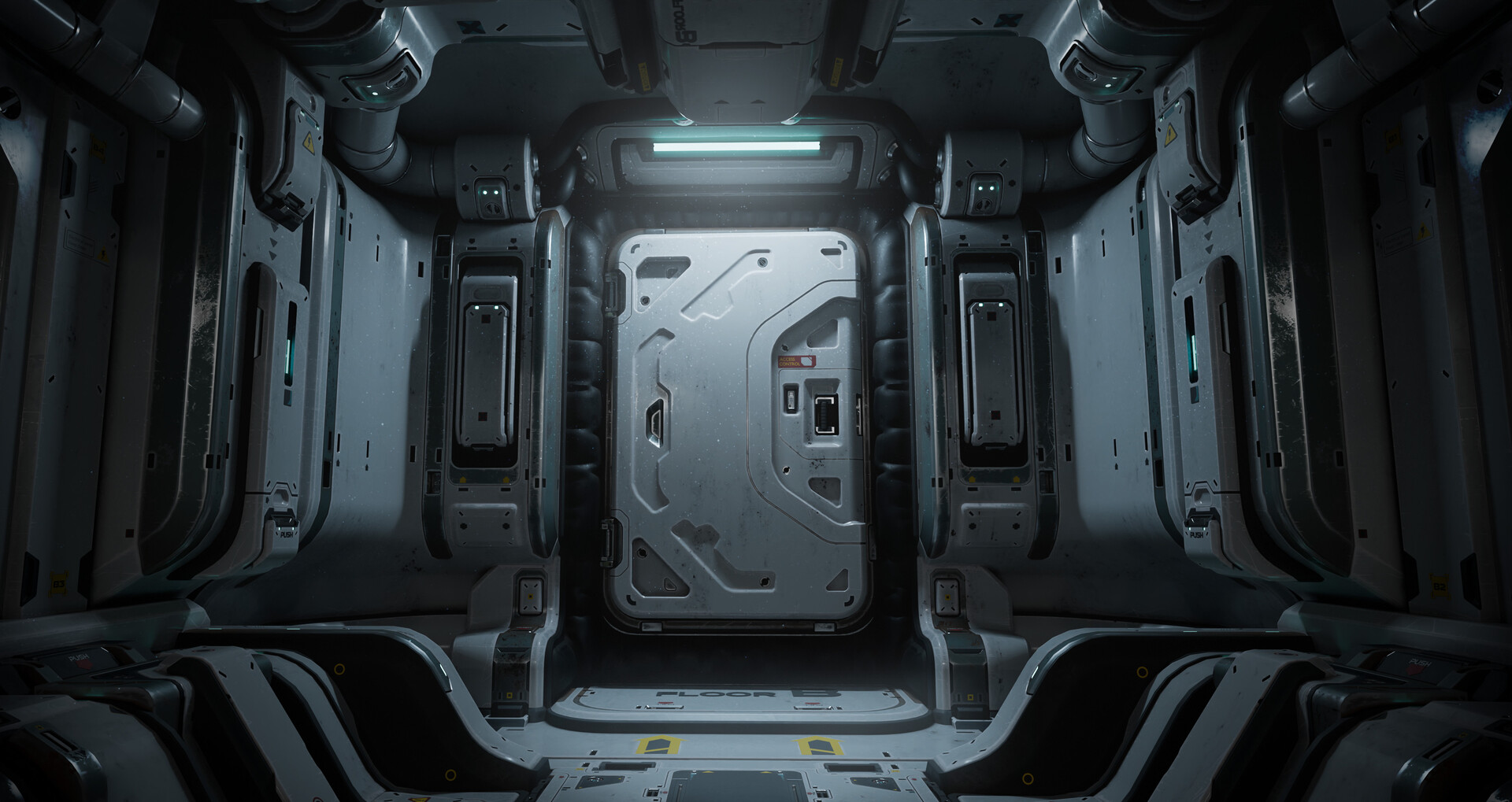
The shaft is a working space, not a room — roughly four metres by eight, the ceiling low enough that taller crew move with habitual caution. The walls are unfinished: structural panels with conduit runs exposed, cable management clips at intervals, a B-line coolant pipe running along the north wall at chest height in insulating wrap patched twice with silver tape. The floor is steel mesh over a maintenance crawl layer, the mesh worn bright at the grip points closest to the work areas.
Gravity here is near-full — SL1 sits at the outermost radius of the ring. You stand on the mesh and stay there. The amber lighting comes from two strip fixtures mounted at the wall-ceiling junctures — warm, slightly orange, casting shadows under every conduit and cable run. The corners of the shaft are dim. The central work area is adequately lit. Adequately is the correct word.
The B-line coolant system, when running, is audible as a low-frequency resonance felt in the soles of your feet and the palms of your hands against the wall more than heard in your ears. Steady. Changes pitch slightly under load.
The north hatch is circular, pressure-rated, wheel-sealed. Steel, grey, the rubber gasket around its rim slightly compressed from years of cycling. The wheel handle is worn bright at the grip positions. The south hatch is identical. On the east wall, between the cable runs, is the viewport: triple-paned, roughly thirty by forty centimetres, the frame bolted directly into the structural panel. The glass is thick enough to slightly curve the image. Through it: the docking bay floor, the clamp hardware, the approach corridor beyond — and depending on the docking angle, the edge of the ice planet.
After the incident: the amber strips are off. Green emergency strips sit at floor level — thin, recessed into the mesh, casting light upward at a flat angle that puts everything below waist height in green and everything above in shadow. The coolant system is silent. The shaft smells of old sealant and cold metal. Anything left unsecured — a loose bolt, a work glove, a length of stripped cable — has settled to the floor over fourteen months. Gravity keeps it there.
The North Corridor
White light warming at the junctions. Handrails. The ice planet in the viewport.
The corridor runs between the maintenance level and the research floors — wide enough for two suited people to pass each other with a deliberate sideways motion. The floor coating is a textured dark grey polymer. After three years it is scratched at the high-traffic areas and still grippy everywhere else.
Handrails run along both walls at shoulder height: round aluminium bar, matte finish, anchored at half-metre intervals. At L1 the gravity is near-full and the rails are a precaution. Higher in the station, as the gravity lightens, they become more useful. In the spoke corridor approaching the hub they become essential — the last few metres before the hub transition are where the floor stops meaning anything.
At the junction where the corridor meets the research level cross-passage, a small triple-paned viewport is set into the outer wall. The ice planet is framed in it — the same fraction of the frame as every other junction viewport, always, because the ice planet does not move. The Praxis-standard junction lighting is slightly yellower than the corridor white. The difference is perceptible. It was designed to break the visual monotony of a long lit passage.
After the incident: the junction yellowing is gone. Green strips at floor level, the same flat upward cast as everywhere else. The frost the helium release put on every surface has since sublimed back into the reserve air cycle — imperfectly — leaving a fine crystalline residue on the viewport glass and the handrail grip surfaces. In the green light the residue catches the angle and glitters slightly. The viewport is fogged at the corners. Through the clear centre: the ice planet, unchanged, in green.
Waste Disposal Pod Bay
The smallest room. Amber light, inadequate. The smell of the system it serves.
The pod bay is accessed through the south hatch of the maintenance shaft. Three metres by five, ceiling at the same height as the shaft, every surface functional. There is no surface that is not serving a purpose.
The rail runs from the inner wall to the ejection port: two parallel tracks, heavy gauge industrial steel, bolted through the floor panel to the structural frame. The capsule is roughly two metres long, one metre in diameter — a rounded cylinder with a single hatch on the near face, sealed with a wheel lock and a rubber gasket. Through the small window in the hatch: foam interior, moulded to accept irregular cargo shapes. Dense, industrial, yellowish. Never cleaned.
The ejection port at the far end is a circular hatch roughly one and a half metres across, sealed from the inside with a manual wheel lock and four locking bolts. A small reinforced window shows the exterior — hull face, darkness, one corner of the ice planet if you press close and look at an angle. The vacuum warning stencilled above the wheel in orange has faded to yellow-orange over three years.
The control panel is bolted to the wall to the right: three levers, no display, labels in Praxis maintenance font. PRESSURISE. SEAL. EJECT. Spring-loaded to resist accidental actuation. You need both hands and deliberate force.
The bay smells. Not dangerously — the systems filter — but the waste processing connection is immediately adjacent and three years of proximity has put something into the ambient air that the filtration does not fully remove. Nobody comes here unless they have a reason.
After the incident: the capsule is gone. The rail holds nothing. The control levers are in post-ejection position — EJECT thrown, the others in sequence before it.
Primary Docking Bay
High ceiling relative to the rest of the station. The smell of vacuum seals and hydraulic machinery.
The docking bay occupies the full cross-section of the central docking module — the largest internal volume on the station. The overhead structure is the underside of the external hull panels, the docking mechanism hardware mounted directly to it: two sets of clamp arms, thick, hydraulic, designed to engage around a vessel's collar and lock mechanically. When they engage you feel it as a low thud through the entire station structure — through the floor, through the walls, through everything attached to anything.
The bay floor is marked in industrial yellow — approach lines, caution zones, standard docking geometry. Faded at the high-traffic areas near the primary position, still bright at the secondary position used once in three years.
On one wall, above the bay floor, is the management window: a wide viewport looking down from the upper management station. Thick glass, internal pressure-rated. From below it reads as a dark panel with a reflection of the bay floor. From above, the whole bay is visible.
The external port at the approach end is a large structural aperture, sealed by pressure doors that open outward on pneumatic arms. When open: the approach corridor, the star field, the ice planet at whatever angle the approach geometry places it. The doors are rated for vacuum differential. They make no sound when they move — sound requires air, and the mechanism was designed for vacuum.
The primary clamp position is occupied. The black ship sits in the collar — dark hull, no running lights, no markings. The clamp arms hold it against the station's pressure collar. Its geometry is compact and low-profile. The approach corridor beyond its stern is occluded by the hull.
The blast scoring on the far clamp housing is a scorched streak across the structural panel: evidence of a departure at thrust settings the bay geometry was not designed for. The panel will need to be replaced eventually.
The Canteen — Level 2
Warm light. The only room on the station that feels like somewhere rather than something.
The canteen is the only room that feels like somewhere rather than something. The lighting is yellowed — a Praxis specification adjusted over three years by the catering staff raising the colour temperature in small increments until it sat at something close to warm natural light. The difference from the corridor white is immediately perceptible when you pass through the hatch. Your eyes relax.
Six tables, bolted to the primary wall in the conventional orientation — laminate surface, rounded corners, slightly raised edge lip. The chairs are fixed to the floor by brackets at standard seating angles. L2 sits at near-full ring gravity. Nothing drifts. The raised lips are a manufacturing standard, not a functional necessity at this level.
The food replicator is built into the primary wall to the left of the hatch — brushed aluminium panel, selection interface worn smooth at the most-used choices. It cycles at meal times with a low mechanical sound, a few seconds of processing, a clunk when the output tray seats. The tray has a safety latch you press to release.
On the corner shelf beside the water reclaimer: a small collection of pressed mineral samples in sealed cases, arranged by colour. They were placed there by someone who is no longer on the station. Nobody thinks of them as objects with an owner anymore. They are part of the room.
After the incident: the warm light is gone. Green strips at floor level, the tabletops in shadow. A cup lies on its side on Table 3, rim against the edge lip. Not moving. Gravity holds it there. The mineral samples on the shelf are invisible in the dimness. The six tables are undisturbed. The seating arrangement still holds. There is no one in it.
Research Lab C — Level 3
Blue-white light. Very still. The specific quiet of a room where people learned not to move unnecessarily.
The research labs are calibrated environments. Lab C is roughly eight metres by six, workstations along three walls, open instrument space in the centre. The lighting is blue-white, flat spectrum, no warmth — the light that research instruments are calibrated for, not the light that people are calibrated for. It makes skin look slightly wrong and you stop noticing after twenty minutes.
The workstations are recessed into the wall panels, surfaces angled slightly toward the user. Foot rails run along the base of each station — angled for comfortable standing posture in reduced gravity, worn smooth at the toe positions. Above some workstations, probe relay hardware is mounted on articulating arms — sensor housings, cable clusters, instrument faces set at angles for comfortable viewing while standing. Some stations have analysis equipment in sealed cases with access ports on the front face.
The room is quiet in a specific way. Not silent — the instrument power supplies make a low tone, a relay clicks occasionally, the active sensor array produces a high-frequency whine you feel in the back of your molars more than hear. But quiet in the way of a room where everyone learned quickly that unnecessary movement creates noise in the instruments. The people who worked here moved with economy. The room retains that quality even empty.
After the incident: the blue-white strips are off. The research terminals are dark and wiped. Eleven dark stations. One station at the far wall, third from the right, is still on — running on the isolated circuit. Its screen shows a scrolling data feed, green text on black, updating at the pace of the archiving loop. In the total dark of the room this screen is the only light source — a small green rectangle at the far wall, casting just enough to make the workstation surface below it visible, its reflection doubled in the polished surface. The rest of the lab is in darkness behind you when you face it.
Maintenance Corridor — Level 3 / Secondary Coolant Housing
A passage that looks like every other passage. Amber, narrow, close walls.
The Level 3 maintenance corridor runs parallel to the research floor, accessible to maintenance crew but not routinely accessed by research staff. Amber lighting, same inadequacy as the shafts below, same shadows at the corners. The corridor is narrower than the research corridors — single-person width, walls close enough that you can touch both sides simultaneously with arms extended.
The walls are panelled in structural composite. At intervals: access panels, circular or rectangular, fastened with hex bolts in Praxis standard configuration. The panels are numbered in stencilled maintenance code. Most show wear at the bolt recesses from regular access. Some show no wear at all — the bolt recesses clean, the stencil paint unscratched.
One panel on the east wall, roughly at chest height: hexagonal frame, six bolts. The bolt recesses are clean. The panel surface has no fingerprints, no surface wear. It has not been opened since installation.
Behind it: a cavity. The secondary coolant routing hardware for the B-line distribution system — pipes in thermal insulation wrap, fittings, a manifold. At the back of the cavity, a layer of spray foam insulation, dark beige, slightly granular. In the foam, a cavity shaped by an object that was placed there and removed. The shape is specific: roughly the size of a fist, slightly irregular. Nothing is in it now.
Dr. Gebreysius's Office
Small. Pressurised. The air is stale but breathable. Your ears adjust when you cross the seal.
The office is between the research labs and the compute room — inner section, on the pressurised side of the emergency seal. The seal is a reinforced hatch with a differential gauge on the near face. When you cross it, the partial vacuum of the outer section gives way to full atmosphere. Your ears adjust. The air in the office is stale — fourteen months of the same recycled volume, the filtration running slow on reserve power. Not bad. Just old.
The room is small: desk, screen mount, two document storage panels, a narrow shelf. No viewport. The desk is positioned against the inner wall. His field of vision from that chair was the door and the opposite wall. The wall has a printed station schematic and a handwritten equipment calibration log on thermal paper, stuck directly to the surface. The log runs from the station's commissioning date to approximately three weeks before the incident, in entries spaced irregularly — sometimes daily, sometimes weekly. The handwriting is consistent throughout. Small. Precise.
The desk surface has anchor points for a work slate and a cup. Both are gone. The surface is clean.
His body is at the desk. The chair has a low restraint bar — standard for the reduced gravity of L4, a precaution rather than a necessity — and it holds him at the waist. He is in the position he was in when he sat down: upright, both hands in front of him. He is not in the condition the kill team left him in. He has been alone for fourteen months. He is at rest.
One hand rests on a piece of thermal paper, folded once. His handwriting is on the outside face.
Under the desk, attached to the underside panel with a strip of insulating tape: a keycard on a lanyard. One word is written on the tape next to it.
The Compute Room — Level 4
Everything else has been dark for fourteen months. This room has not.
The compute room door is at the end of the inner section corridor, set slightly recessed into the wall. Heavier than the standard hatches — a sealed interior door. The authentication panel to the right: a card reader and a biometric pad. The biometric pad's indicator is off, on the main grid. The card reader has its own circuit. Its indicator light is amber.
Inside: approximately ten metres by twelve. Twelve workstations in two rows facing the central processing stack. The workstations are dark — screens off, keyboards covered. The central stack is a column of compute hardware roughly two metres tall, active indicator lights cycling in a slow green rhythm. The sound of the stack is a low steady tone — fans, heat exchange, active processes. It is the only sound in the room. It has been the only sound in the room for a long time.
Two probe telemetry relay arrays are mounted on the wall opposite the door: equipment racks roughly two metres by one each, indicator lights active, connection ports labelled in maintenance stencil. The relay feeds are live — screens above the arrays showing data updates that have been running since the main grid went down. These are the brightest light in the room. They cast the workstation rows in cold white, the shadows of the processing stack columns stretching back toward the door.
The room smells of active electronics: dry, slightly metallic, the particular ambient of heat-producing hardware in an enclosed space. It is the smell of a room that has been working.
You are the first person to stand in this room in fourteen months. The screens have been updating. The indicator lights have been cycling. Nobody has been watching.
Upper Decks — Levels 5 and 6
Research management. Senior quarters. The communications hub. More viewports than the lower levels — designed with some consideration for the psychology of senior staff spending years far from everything.
The upper decks are the only part of the station with viewports in the living spaces rather than just at corridor junctions. The rooms are slightly larger than the research levels, the ceilings slightly higher. These were the better postings on a station with no good postings: the ones assigned by seniority and duration.
The hatches to the upper decks are unlocked. The corridors are accessible. There is no barrier preventing you from going up.
What you find there is not described here.
The Ice Planet
It is always in the viewport.
Every corridor junction on the station has a small viewport — triple-paned, facing the same direction because the station's position and orientation are fixed. What they face is roughly toward the planet.
The planet is large enough in frame that you cannot see all of it through a single viewport. The edge is visible: a curve of absolute darkness against the star field, the line between planet and space sharp enough to look wrong. No atmosphere. No scattering. The planet ends and space begins with the precision of a cut edge.
No surface detail is visible from the station. No light falls on the face toward you — the system star is far, and the planet sits in the electromagnetic shadow the station was placed here specifically to exploit. What you see is the shape. The mass. The specific quality of something very large that is not reflecting anything back at you.
In three years of operation, the station's monthly emergency lighting tests put every junction viewport into green 520nm light for four minutes each. Every crew member on the station saw the ice planet forty-three times in that colour. It looked like this: the same curve of darkness, the same sharp edge, in a different colour.
After the incident the green strips are on continuously. The planet is always in the viewport in green now.
At the gravitational centre of the Veridion system — not the planet, a different bearing entirely, out into the open dark — the probe array has been recording a signal for fourteen months. The compute room's visualization system renders it spatially. On the display: something small, bluish, at the edge of resolution. Growing. The waveform says it is not as small as it looks.
Technical Reference
Physical Layout
| Section | Level | Notes |
|---|---|---|
| Research Labs A–C | Levels 2–4 | Instrument calibration environment, blue-white lighting spec; all dark post-incident |
| Canteen | Level 2 | Six tables, food replicator, warmest lighting on station |
| Maintenance Shafts | All levels | Amber lighting; the infrastructure below the floor; where Janus works |
| Maintenance Shaft Section 4 | Sub-Level 1 | Story start. North hatch to corridor; south hatch to pod bay; reinforced viewport to docking bay |
| Secondary Coolant Housing | Level 3 | Access panel unopened since installation; Ana's hide |
| Waste Disposal Pod Bay | Sub-Level 1 | Single waste ejection capsule on rail; manual controls only; no authentication |
| Primary Docking Bay | External | The black ship is attached here |
| Compute Room | Level 4 | Isolated circuit; probe array relay; live data; the bearing resolves here in Return |
| Upper Decks | Levels 5–6 | Screaming. Not accessible. |
Structural Notes
- Construction: Standard Praxis modular — interlocking hexagonal sections
- Gravity: Ring section rotates — ~0.9g at SL1/L1, ~0.7g at L3, ~0.5g at L5/L6, 0g at hub; spoke corridors are transition zones
- Power (operational): Main grid fed from reactor
- Power (post-incident): Emergency battery — green strips, manual systems only; isolated compute circuit still active
- Comms: Dark post-incident; emergency Fabric relay burst transmitted pre-shutdown
- Docking: Primary bay sealed by black ship attachment; waste pod bay manual-release only
- EM environment: Reduced background interference from ice planet shadow — why the station was placed here
Writer's Notes
The station in peacetime is not the station in crisis. These are two different locations that happen to occupy the same structure.
In peacetime, the dramatic irony is total: the reader knows everyone in these scenes is dead or missing. The characters do not. Handle this without comment. Let it sit in the negative space.
In crisis, the tone shifts to the precise and kinetic. The green lighting is not described as ominous — it is described accurately, as the specific frequency it is, and the accuracy is what makes it ominous.
The Flicker is background noise in peacetime. It does not announce itself. It does not produce sensation. This should be felt in the prose: the station's work is important and invisible to the people doing it. Their significance is a function of what they find, not how it feels to look.
See also: Locations Index | The Flicker | Setting | Story — Echos in the Cold | Story — Before the Incident | Characters — Janus | Characters — Ana